The best flat top grills for backyard cooking are the Weber Slate 30-inch for easier temperature control, the Blackstone 36-inch Culinary Griddle for maximum cooking space, and the Traeger Flatrock 3-Burner for households that want premium construction and multiple heat zones.
A flat top grill is most useful when you cook breakfast, smash burgers, fajitas, cheesesteaks, vegetables, or several foods at once. Unlike a conventional grate, its solid steel surface prevents small ingredients from falling through and lets you move food between hot and cooler areas. The right choice depends less on headline burner output than on usable cooking area, grease flow, fuel setup, and how much space you have for storage and assembly.
As an Amazon Associate we earn from qualifying purchases at no extra cost to you.


Our Top Picks
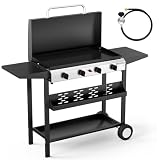
 Bonnlo 40000BTU Propane Griddle with Lid and Ignition52.4"L x 15.4"W x 35.4"H15.4 x 52.4 x 35.4 inchesCheck on Amazon
 LAUDLIFE 5-Burner Propane Grill Griddle Combo with Side21.65 x 63.39 x 40.55 inches84 PoundsCheck on Amazon
 Chefman XL Electric Griddle with Removable Temperature Control10" x 20"11.7 x 21.4 x 3.2 inches4.4 PoundsCheck on Amazon
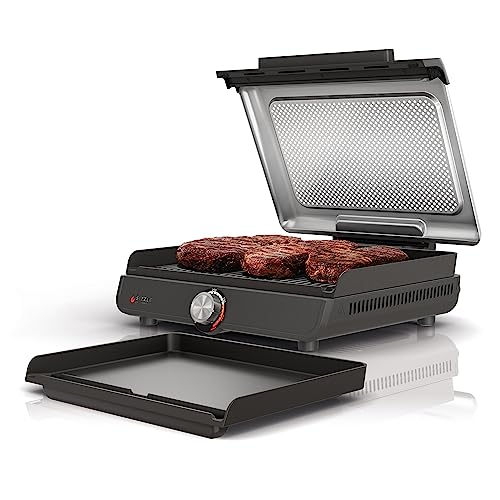
Top 3 picks at a glance
Best flat top grills at a glance
| Grill | Cooking area | Burners and output | Best for | Typical market range |
|---|---|---|---|---|
| Weber Slate 30-inch | Approximately 540 sq. in. | 3 burners, about 36,000 BTU | Even heating and compact patios | Usually $500–$700 |
| Weber Slate 36-inch | Approximately 756 sq. in. | 4 burners, about 60,000 BTU | Large families and frequent entertaining | Usually $700–$900 |
| Blackstone 28-inch Culinary Griddle | Approximately 524 sq. in. | 2 burners, about 34,000 BTU | Smaller outdoor spaces and value | Usually $250–$400 |
| Blackstone 36-inch Culinary Griddle | Approximately 768 sq. in. | 4 burners, about 60,000 BTU | High-volume cooking and meal prep | Usually $350–$550 |
| Traeger Flatrock 3-Burner | Approximately 594 sq. in. | 3 burners, about 45,000 BTU | Premium three-zone cooking | Usually $700–$900 |
Cooking-area figures are useful comparisons rather than promises of identical usable space. Some models include warming sections or curved edges that are less practical for food. Burner output also does not translate directly into better cooking: heat distribution, wind resistance, plate thickness, and control quality matter just as much.
Our top picks by cooking style
Best overall for most backyards: Weber Slate 30-inch
The 30-inch Weber Slate is a strong middle-ground choice for couples, small families, and cooks who want a flat top that is easier to manage than a full-size four-burner model. Its three burners create useful left, center, and right heat zones, so you can sear burgers on one side while warming buns or holding cooked food at a lower temperature.
The main advantage is temperature control. A flat top can develop hot spots, especially when the burners are packed closely together. Weber’s design is aimed at more consistent surface temperatures and includes a carbon-steel cooking surface that is intended to be ready for cooking without the lengthy initial seasoning process associated with some bare griddles.
Choose this model when your typical meal serves two to six people and you want a freestanding grill that does not dominate a patio. The 36-inch version is better if you regularly cook a full breakfast, several burgers, and vegetables simultaneously.
Best for maximum capacity: Blackstone 36-inch Culinary Griddle
The Blackstone 36-inch Culinary Griddle remains a practical choice for large batches. Its approximately 768 square inches of surface area can handle pancakes for a group, a dozen or more burgers depending on spacing, or separate ingredients for a full outdoor meal.
Four independently controlled burners are the key feature. You can run two burners high for browning, one burner medium for vegetables, and one burner low as a holding area. This arrangement is more useful than simply having extra BTUs because it lets you cook ingredients with different temperature requirements at the same time.
The trade-off is footprint. Measure the grill, both shelves, and the clearance required by the manufacturer rather than measuring only the cooking plate. A 36-inch griddle can become awkward on a narrow balcony or small concrete pad. It is also heavier and typically takes longer to assemble than a two-burner model.
Best compact option: Blackstone 28-inch Culinary Griddle
The 28-inch Blackstone is a sensible fit for smaller patios, occasional cooks, and households that do not need four independent heat zones. Its two burners provide a hot side and a cooler side, which is enough for many everyday meals but less flexible for a large breakfast or party.
Its portable-friendly size is useful if you need to move the grill into storage after each use. Before buying, confirm the exact configuration: some versions are sold with a cart, while others are designed for tabletop use or have different shelf arrangements. A tabletop model still needs a stable, heat-resistant support and safe clearance from walls and railings.
Best premium three-zone design: Traeger Flatrock 3-Burner
The Traeger Flatrock 3-Burner targets cooks who want a substantial cooking surface without moving to a four-burner chassis. Its three burners offer a practical high-medium-low arrangement, while the broad surface works well for burgers, chopped vegetables, tortillas, and breakfast foods.
It is generally positioned above basic griddles in price, but the extra cost can make sense if you value heavier construction, a more finished cart, and features intended to improve wind protection and grease handling. It is less compelling for occasional use or a tight budget, where a two-burner griddle can produce similar food with fewer conveniences.
How to choose the right size and heat layout
Use this decision matrix before focusing on brand names:
| Your situation | Recommended class | Why |
|---|---|---|
| Two to four people, limited patio | 28–30 inches, 2–3 burners | Enough capacity without wasting fuel or floor space |
| Four to six people, mixed foods | 30–36 inches, 3–4 burners | Creates separate searing, cooking, and holding zones |
| Weekly entertaining or meal prep | 36 inches, 4 burners | More usable surface and less crowding |
| Camping, tailgating, or frequent storage | Tabletop or folding 22–28-inch class | Lower weight and easier transport |
| Natural-gas outdoor kitchen | Natural-gas-compatible built-in or cart model | Avoids repeated propane-cylinder changes |
To estimate capacity, allow roughly 40–60 square inches per large burger when you include space for turning and moving food. A 768-square-inch plate therefore has plenty of theoretical room for 12–16 burgers, but practical capacity will be lower if you are also cooking buns, onions, bacon, or vegetables. Crowding traps steam and reduces browning, so buying a larger griddle is worthwhile when you often cook several food categories at once.
Heat zones matter more than maximum BTUs
A useful three-zone setup is high heat for searing, medium heat for most cooking, and low heat for warming. For example, on a four-burner grill, run the two left burners at high, the third at medium, and the fourth at low. Start burgers over the high zone, move them to medium after browning, and keep toasted buns or finished food on low.
For breakfast, use medium heat across most of the surface and reserve one low zone for pancakes that brown too quickly. For smash burgers, preheat the center at high for several minutes, then reduce one burner after the first batch if the surface becomes excessively dark. The goal is not to operate every burner at maximum output; it is to maintain a controllable temperature gradient.
Grease management: the feature that affects cleanup most
Look for a grease channel that slopes toward a removable cup or tray. A front-access tray is usually easier to empty than a container hidden under the plate, especially when the griddle is against a wall. Check whether the tray can be removed without lifting the cooking surface and whether disposable liners are available for that model.
After cooking, scrape food debris toward the channel while the surface is still warm, but not dangerously hot. Remove excess grease before it hardens. Do not pour water onto a hot steel plate: rapid cooling can warp the surface, and steam can cause burns. Once the plate is warm rather than scorching, wipe it, apply a thin layer of cooking oil if the manufacturer recommends it, and cover the grill only after it is dry.
Propane, natural gas, and portability
Propane is the most flexible fuel because a standard cylinder can power the grill almost anywhere outdoor cooking is permitted. A full-size griddle may consume roughly 1.5–2 pounds of propane per hour at sustained high output, although real use varies because burners cycle and are rarely operated at maximum continuously. A 20-pound cylinder contains about 4.7 gallons of propane, equivalent to approximately 20 pounds, so a theoretical 2-pound-per-hour rate suggests around 10 hours of maximum-output operation. In normal mixed-temperature cooking, actual runtime is often longer.
Natural gas is convenient for a permanent patio installation, but a natural-gas model or approved conversion must match your supply pressure and connector. Never improvise a conversion with an incompatible regulator or hose. Portable models are easier to store, but folding legs and smaller plates usually mean less stability and fewer heat zones.
Assembly and ownership costs
Expect a cart-style griddle to require more than simply attaching a propane hose. Assembly commonly includes wheels, shelves, handles, burner controls, grease components, and the cooking plate. Set aside about 45–120 minutes, use a second person for heavy plates, and check that the frame is level before tightening every bolt. A tilted griddle can send oil toward the wrong edge and make grease management less predictable.
Budget beyond the grill for a weather cover, a long-handled scraper, heat-resistant gloves, an infrared thermometer, and a cylinder if you do not already own one. An infrared thermometer is especially useful during the first few cooks: compare several points across the plate rather than trusting a single reading. A 50–75-degree Fahrenheit difference between zones is not automatically a defect, but it tells you where to place delicate foods.
Frequently asked questions
Do flat top grills need to be seasoned before cooking?
Some flat top grills are designed to be ready for cooking without the lengthy initial seasoning associated with some bare griddles. The Weber Slate’s carbon-steel cooking surface is described this way in the article. For any model, follow the manufacturer’s instructions, and after cleaning apply a thin layer of cooking oil if the manufacturer recommends it.
How many burgers can a 36-inch griddle cook?
A 36-inch griddle can theoretically fit 12–16 burgers, but practical capacity will be lower when you also cook buns, onions, bacon, or vegetables. The article recommends allowing roughly 40–60 square inches per large burger, including room for turning and moving food. Avoid crowding because trapped steam reduces browning.
Can a flat top grill be used on a balcony or narrow patio?
A flat top grill can fit some smaller outdoor spaces, but you must measure the complete setup and follow the manufacturer’s clearance requirements. Include the cooking unit, shelves, and required space around it rather than measuring only the plate. A 36-inch griddle may be awkward on a narrow balcony or small concrete pad.
What should I do with grease after cooking?
Scrape debris toward the grease channel while the surface is warm but not dangerously hot, then remove excess grease before it hardens. Do not pour water onto a hot steel plate because rapid cooling can warp it and steam can cause burns. Once the plate is warm rather than scorching, wipe it and let it dry before covering the grill.
Is a tabletop griddle safe to use without a cart?
A tabletop griddle needs a stable, heat-resistant support and safe clearance from walls and railings. Some compact models are sold for tabletop use, while others include a cart or different shelf arrangements, so confirm the exact configuration before buying. The article also identifies tabletop or folding models in the 22–28-inch class as easier to transport and store.
Final buying advice
Choose the Weber Slate 30-inch when balanced heating, manageable size, and everyday versatility matter most. Choose the Blackstone 28-inch for a smaller space or lower-cost entry, and the Blackstone 36-inch when batch cooking and entertaining justify a larger footprint. Choose the Weber Slate 36-inch for a premium large-format option, or the Traeger Flatrock 3-Burner when you want a refined three-zone layout without moving to the biggest chassis.
Whichever model you select, prioritize a cooking area that leaves room to move food, at least two independently controlled heat zones, a removable grease tray, and a fuel arrangement suited to your patio. Those details determine whether the griddle remains convenient after the novelty wears off.