The best pop-up gazebo for most people is a commercial-grade 10×10 straight-leg aluminum canopy with a 500D–600D polyester top: it sets up in about two to five minutes with two people, holds up for several seasons of sun, and typically runs $250–$450. If you only need shade a handful of weekends a year, a $90–$180 steel-frame 10×10 with a 210D–300D top is the smarter buy, because the canopy fabric — not the frame — is almost always what fails first. Below is a straight breakdown of the six specs that decide whether a pop-up gazebo lasts one summer or five.
As an Amazon Associate we earn from qualifying purchases at no extra cost to you.


Our Top Picks
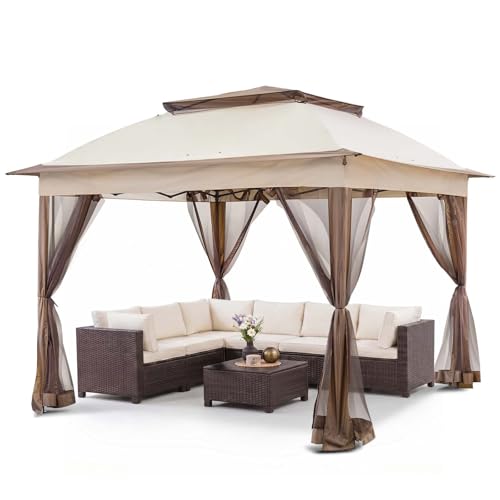
 MASTERCANOPY Pop Up Gazebo with Netting Screen Walls11x11132 x 132 x 116.4 Inches45.72 poundsCheck on Amazon


Top 3 picks at a glance
Quick comparison: the five gazebo classes worth buying
These are spec classes rather than single SKUs, because most brands rotate models every year while the underlying frame and fabric grades stay the same. Where a long-running family is useful as a reference point, it’s named.
| Pick | Best for | Canopy & frame | Packed size / weight | Typical price |
|---|---|---|---|---|
| Commercial-grade 10×10 straight-leg (E-Z UP Pyramid / Eurmax Premium class) | Best overall | 500D–600D top, aluminum frame, full truss bars on all four sides | ~60–66 in bag, 40–55 lb | $250–$450 |
| Value 10×10 straight-leg (Coleman Instant Canopy / Ozark Trail class) | Best budget | 210D–300D top, steel frame, corner trusses only | ~58–62 in bag, 28–36 lb | $90–$180 |
| Heavy-duty weather canopy, 10×10, vented peak | Best for wind and rain | 600D PU-coated top, aluminum frame, 4 trusses per side, peaked roof | ~62–68 in bag, 45–58 lb | $300–$550 |
| Hub-style instant pop-up or screened shelter (Clam Quick-Set / Gazelle class) | Best for camping | 150D–300D top, hub-and-pole frame, often with mesh walls | ~50–60 in folded, 20–35 lb | $120–$300 |
| 12×12 or 13×13 straight-leg | Best for large gatherings | 300D–500D top, steel or aluminum, needs two people | ~65–72 in bag, 45–70 lb | $200–$500 |
Best overall: commercial-grade 10×10 straight-leg aluminum
This is the class where the frame stops being the weak point. Per the manufacturers’ spec sheets, these canopies use aluminum legs roughly 30–40 mm across with a 1.2–1.5 mm wall, and they run diagonal truss bars along all four eaves instead of just the corners. That trussing is what stops the roof from racking sideways when a gust hits one corner, and it’s the single biggest difference between a $150 canopy and a $350 one.
Who it suits: anyone leaving the canopy up on a patio for a full season, or using it twice a month for tailgates, markets, and parties. Main trade-off: 40–55 lb in the bag and a bag that’s around 5 feet long. It is not a one-person carry, and it won’t fit across most sedan trunk openings — plan on the back seat or an SUV cargo area.
Best budget: value 10×10 straight-leg with a 210D–300D top
Budget canopies are perfectly good shade; they’re just not long-life shade. The frame is steel with thinner walls and fewer trusses, so it flexes more, and the top is a lighter Oxford weave that fades and eventually tears at the corner pockets after a season or two of full-sun exposure. The Coleman Instant Canopy and Ozark Trail families are the well-known examples of this class.
Who it suits: renters, occasional backyard use, one or two events a year. Main trade-off: expect a one-year warranty and a canopy that may need replacing before the frame does — budget for a replacement top at roughly 40–60% of the original price.
Best for wind and rain: heavy-duty 600D with a vented peak
Two features matter here. First, a peaked or vented roof: flat-roof canopies pool water, and a few inches of standing water on a 10×10 roof is well over 100 lb of load in the middle of the frame. Second, a 600D PU-coated top with reinforced, double-stitched corner pockets — those corners take nearly all the tension, and they’re where cheap canopies split.
Who it suits: coastal properties, open fields, and anyone who leaves a canopy up through storm season. Main trade-off: weight and price. Adding sidewalls increases the sail area dramatically, so ballast requirements go up with them (see the anchoring math below).
Best for camping and quick shade: hub-style instant pop-ups
Hub frames genuinely set up faster than a traditional pop-up: you pull the walls apart and the frame snaps into shape, usually in well under 60 seconds for one person. Screened versions (the Clam Quick-Set and Gazelle classes) trade open shade for insect protection, which is the right call for a campsite and the wrong call for a vendor stall.
Who it suits: solo campers, beach days, picnics. Main trade-off: smaller usable footprint and a lower peak — often 7–8 ft at the center — plus they need staking or sandbagging every single time, since a light hub frame is the most wind-vulnerable design here.
How to choose: the numbers that actually matter
Frame strength
- Straight-leg vs. slant-leg: a 10×10 slant-leg canopy gives you only about 8×8 ft of full-height usable area (roughly 64 sq ft) because the legs angle inward at the top. Straight-leg gives the full 100 sq ft. Same price bracket, 36% more shade.
- Truss count: count the diagonal bars along each eave. Corner-only trusses signal a budget frame; continuous trusses on all four sides signal a commercial one.
- Leg wall thickness: below about 0.8 mm, steel legs dent when someone trips over a footplate.
Canopy material
Denier (D) measures thread weight, and it’s the fastest way to grade a top: 150D–210D is entry level, 300D is the mid-range sweet spot, and 500D–600D is commercial. Look for a PU coating for waterproofing, a silver or white underside to reflect heat, and a UPF 50+ rating, which blocks about 98% of UV. For any canopy sold for camping use, check for a CPAI-84 flame-resistance rating — many jurisdictions require it on tents and canopies.
Setup time
Marketing says 60 seconds; realistically, a 10×10 pop-up takes 30–60 seconds to unfold, another 60–90 seconds to pull the top over the frame, and 2–5 minutes to stake and ballast it. Call it 3–7 minutes for one person, 2–3 minutes for two. The ballasting step is the one people skip, and it’s the one that matters.
Weather resistance: the anchoring math
Wind pressure follows the standard formula q = 0.00256 × V², where q is pounds per square foot and V is wind speed in mph. Multiply by the 100 sq ft of a 10×10 roof and you get the bare minimum static uplift:
| Wind speed | Pressure (psf) | Uplift on a 10×10 roof | Practical ballast target |
|---|---|---|---|
| 15 mph | 0.58 | ~58 lb | 75–100 lb |
| 20 mph | 1.02 | ~102 lb | 130–200 lb |
| 30 mph | 2.30 | ~230 lb | 300–450 lb |
The right-hand column is the honest one: the raw pressure figure ignores the shape factor for a sloped canopy roof, which typically runs 1.3–2.0, so the real load is meaningfully higher than the table’s middle column. This is why manufacturer guidance usually caps use at 20–30 mph and tells you to take the canopy down in a storm. Practically: four sandbags or water barrels at 25–30 lb each on the feet is the floor, not the ceiling, and you should never rely on stakes alone in soft ground.
Packed size and portability
A 10×10 straight-leg packs into a bag roughly 60–66 in long and 10–14 in square. Measure your trunk opening before buying — most sedan trunks are around 40–48 in wide, so a 5-foot bag rides in the back seat. Wheeled bags add 2–4 lb but are worth it above about 35 lb total. A 12×12 typically needs two people to lift overhead, and that’s the real portability threshold to watch.
Shade math: how much shade a 10×10 really casts
A canopy’s shade isn’t limited to its footprint. The shadow extends beyond the leeward edge by roughly the canopy height divided by the tangent of the sun’s elevation angle. Take an 8-ft side height:
- Sun at 60° (midday, summer): 8 ÷ 1.73 ≈ 4.6 ft of overhang, so the shaded strip is about 10 × 15 ft.
- Sun at 45° (mid-afternoon): 8 ÷ 1.0 = 8 ft, giving roughly 10 × 18 ft.
- Sun at 30° (late afternoon): 8 ÷ 0.58 ≈ 13.8 ft, but the shadow is oblique — light passes under the valance and lights a strip of the ground directly beneath the canopy edge, so the usable shaded zone is narrower than the geometry suggests.
The takeaway: a 10×10 is a solid mid-day shade structure and a mediocre late-afternoon one. If your use is 4–7 p.m., add a sidewall on the sun-facing side. If you’re using the shade for an outdoor screen or projector setup, that same late-afternoon low sun is what washes out the image — the sidewall matters more than the roof.
Decision matrix: match the gazebo to your situation
| Your situation | Recommended class | Why | Typical price |
|---|---|---|---|
| Patio, up all summer | Commercial aluminum 10×10, 500D+ top | Frame and fabric both survive UV and repeated flexing | $250–$450 |
| Two or three events a year | Value steel 10×10, 210D–300D top | Cheaper to replace than to maintain | $90–$180 |
| Exposed site, wind and rain | 600D vented-peak heavy-duty | Peak sheds water; thicker fabric resists flutter damage | $300–$550 |
| Solo camping or beach | Hub-style instant pop-up | One-person setup in under a minute | $120–$300 |
| Seated dinner for six | 12×12 straight-leg | A 6-ft table plus chairs needs about 11 × 11 ft of clearance | $200–$500 |
Frequently Asked Questions
How long does a pop-up gazebo take to set up?
Plan on 3–7 minutes for one person and 2–3 minutes for two. Unfolding the frame takes under a minute, but pulling the canopy over the top and then staking and ballasting all four feet is where the rest of the time goes. Ballasting is the step worth not rushing, since an unanchored canopy is the main cause of wind damage.
Can a pop-up gazebo stay up in the rain?
Yes, if the top is PU-coated and the roof is peaked or vented so water runs off instead of pooling. A flat-roof canopy can collect enough standing water to bend the frame, and a few inches of water across a 10×10 roof weighs well over 100 lb. Even with a good canopy, manufacturers generally advise taking it down before sustained winds reach 25–30 mph.
What wind speed is too much for a pop-up canopy?
Most manufacturer guidance caps normal use at 20–30 mph, and that assumes all four feet are anchored. Using the standard wind pressure formula, a 20 mph wind produces about 1 psf on a 10×10 roof, or roughly 100 lb of uplift before any shape factor is applied — which is why the practical ballast target is 130–200 lb at that speed, not 100 lb.
Is a 10×10 big enough for a table and six chairs?
Usually not comfortably. A 6-foot table needs about 30 inches of chair clearance on each long side, which puts the required footprint at roughly 11 × 11 ft once people are seated. A 10×10 works for standing crowds or a buffet setup, but for a seated dinner of six, go 12×12 or run the table diagonally and accept tighter seating at the ends.
What’s the difference between slant-leg and straight-leg canopies?
Straight-leg canopies give you the full advertised footprint — a 10×10 is 100 sq ft of full-height shade. Slant-leg canopies angle the legs inward, so a 10×10 base yields only about 8×8 ft, or roughly 64 sq ft, of usable area under the roof. Slant-leg models are slightly cheaper and pack shorter, but straight-leg is better value per square foot of shade.
Do I need sidewalls?
Sidewalls help most in late afternoon, when the sun drops below 45° and starts coming in under the canopy edge, and they add privacy and wind blocking. The catch is sail area: a full set of sidewalls can multiply the wind load on the frame, so add ballast at each foot if you’re running them. Many people buy one or two panels rather than a full set.