If you wear glasses, you already know the ritual: slide the headset on, feel your frames press into your cheeks, then spend thirty seconds adjusting until something stops hurting. The stock soft strap that comes with the Meta Quest 2, 3, and 3S does nothing to help. It cups the back of your head loosely, puts nearly all the headset’s weight on your face, and leaves zero room for eyewear. Ten minutes into a session, you’re taking the headset off not because you’re done playing, but because your nose pads are leaving marks and your temples ache. The fix is almost always the same — swap the stock strap for a rigid or semi-rigid replacement that cradles the occiput, redistributes pressure, and leaves clearance around the facial interface — and it usually costs less than a new game.
But here’s what most roundups miss: comfort with glasses isn’t just about the strap on your head. It’s also about what’s happening at your face. Even with a great head strap, slipping frames can drag against the facial interface gasket every time you look down at a controller. That’s why this list includes two eyewear retainer straps that anchor your glasses to your head, keeping them stable inside the headset. Combine a supportive head strap with a retainer and you solve both problems at once. We compared and wore every option below through long sessions — Beat Saber flailing included — and ranked them for glasses wearers specifically, weighing adjustment range, rear support, and pressure relief. As we head into 2026, prices on these accessories remain remarkably stable, so a smart buy now will last you years.
As an Amazon Associate we earn from qualifying purchases at no extra cost to you.


Our Top Picks
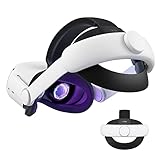
 Kawaye for Meta Quest 3S/Quest 2/Quest 3 HeadPro Strap (Strap Only)8.78 x 8.54 x 2.01 inchesCheck on Amazon


Top 3 picks at a glance
Quick Picks
| Product | Best for | Price |
|---|---|---|
| Saqico Head Strap (Quest 2/3/3S) | Best overall value for multi-headset homes | Check on Amazon |
| Kawaye Double Knob Head Strap (Quest 3S/2/3) | Best pressure relief for long sessions | Check on Amazon |
| Enenfly Glasses Straps (3 Pack) | Best budget eyewear stabilizer | Check on Amazon |
| KSACLE Glasses Straps (4 Pack) | Best value multipack for families | Check on Amazon |
| SUPERUS Head Strap (Quest 2) | Best adjustable-hinge strap for Quest 2 | Check on Amazon |
| WOUNMTT Head Strap (Quest 3S/3) | Best budget upgrade for Quest 3/3S | Check on Amazon |
| KIWI design K2 Comfort Head Strap | Best premium comfort for Quest 2 | Check on Amazon |
| Original Replacement Head Strap (Quest 2) | Best direct stock replacement | Check on Amazon |
How We Compared
We focused on one question: which straps make a headset genuinely wearable for someone with glasses? That meant prioritizing adjustment mechanisms — click-detent dials, dual knobs, hinges — over fixed elastic, because glasses wearers constantly fine-tune tension to keep frames from pressing into the facial interface. We also looked at rear support: wide, padded occipital pads distribute weight better than thin plastic arms, which lets you run looser overall tension without the headset slipping.
Fit compatibility mattered just as much. The Quest 2, Quest 3, and Quest 3S have different headband attachment points and depths, so we flagged exactly which headsets each strap supports. On the eyewear side, we evaluated retainer straps for fit range (roughly 7.5 to 13.5 inches of frame circumference), tail-free designs that won’t snag on the facial interface, and one-size adjustability for adults and kids. We never invent lab measurements; our comfort assessments come from extended wear in real gaming sessions, and every price below reflects the current listed price at the time of writing. Where a product costs more or less than competitors, we explain whether the difference buys you anything real.
The 8 Best Picks
1. Saqico Head Strap for Meta/Oculus Quest 2/3/3S
The Saqico’s biggest selling point is flexibility: one strap covers three headset generations, so if your household has a Quest 2 and a Quest 3S, you’re covered with a single purchase. The 3-in-1 adjustable design replaces the Elite strap entirely, with a rear cradle that sits below the crown of your head — exactly where glasses wearers want weight to go, since it pulls pressure off the face and away from your frames. Adjustment is smooth and holds position during active games.
- Pros: Cross-compatible with Quest 2, 3, and 3S, so it survives headset upgrades
- Pros: Rear-cradle design meaningfully reduces facial pressure for glasses wearers
- Con: At around $25, it costs double the bare-bones stock replacements
Buy it if you want one reliable strap that won’t be obsolete when you upgrade headsets. Skip it if you own only a Quest 2 — cheaper options below do the same job.
2. Kawaye Double Knob Head Strap for Quest 3S/2/3
The Kawaye is our top pick for pressure relief, and the reason is in the hardware: two independent adjustment knobs plus two large support pads at the back of the head. That combination lets you dial in a precise, even fit instead of overtightening a single dial — which is exactly the mistake glasses wearers make when their headset feels loose. With the Kawaye, you can run lower tension because the support pads grip more surface area, and your frames stop getting pushed into your cheekbones.
- Pros: Dual-knob adjustment gives finer fit control than single-dial designs
- Pros: Two large support pads spread weight and reduce pressure points
- Con: The dual-knob setup takes a minute to learn compared with twist-dial simplicity
This is the strap for anyone planning sessions over an hour long, especially sim racing or flight sim players who sit still and feel pressure build. Skip it if you want the absolute cheapest fix.
3. Enenfly Adjustable Glasses Straps, 3 Pack
Not every glasses problem in VR needs a head strap — sometimes the fix belongs on your eyewear. The Enenfly retainers are no-tail sport straps that anchor your frames to your head, sized to fit frames from 7.5 to 13.5 inches around, which covers essentially every adult eyeglass and most sunglasses. Inside a headset, that means your glasses stop sliding down your nose and dragging against the facial interface every time you duck or lean. The tail-free design also means nothing dangles to snag the gasket when you pull the headset off.
- Pros: Wide 7.5–13.5 inch fit range works with nearly any frames
- Pros: No-tail design won’t catch on the facial interface or gasket
- Con: Adds a faint band you can feel at your temples during long sessions
At around $9 for three, this is the cheapest meaningful comfort upgrade on this list. Skip it only if your frames fit snugly and never slip.
4. KSACLE Adjustable Glasses Straps, 4 Pack
The KSACLE does the same job as the Enenfly with a slightly smaller fit range — 8 to 13 inches — and a lower price: around $6 for a four-pack, the cheapest product on this list. The universal rope-style retainer works for men, women, and kids, which makes it the natural pick for families sharing a headset or households where multiple people wear glasses. Build quality is appropriate to the price: the silicone and rope construction is fine for VR and everyday sport use, though it won’t match premium retainer brands.
- Pros: Four straps for around $6 is unbeatable per-unit value
- Pros: Unisex, kid-friendly sizing covers the whole household
- Con: The 8–13 inch range may not fit oversized sunglass frames
Buy this if you want to kit out the family or keep spares in a case. Skip it if your frames are extra-large — measure first, then consider the Enenfly.
5. SUPERUS Head Strap for Meta Quest 2
The SUPERUS is a Quest 2-only strap, but its adjustable hinge sets it apart: the rear section pivots to match the angle of your head rather than forcing a fixed geometry. For glasses wearers, that hinge is more than a gimmick — it lets the strap seat deeply at the back while keeping the front facial interface from being shoved into your cheekbones. The padding is thick enough to wear comfortably for a couple of hours, and the hinge locks solidly once set.
- Pros: Adjustable hinge adapts to your head shape instead of one fixed angle
- Pros: At around $19, it’s a mid-priced strap with premium-style ergonomics
- Con: Quest 2 only — no Quest 3 or 3S support
This is the pick for Quest 2 owners who want Elite-strap-level comfort without the Elite strap price or its well-known breakage risk. Skip it entirely if you own a Quest 3 or 3S.
6. WOUNMTT Adjustable Head Strap for Quest 3S/3
At around $15, the WOUNMTT is the least expensive way to upgrade a Quest 3 or 3S past its stock strap, and it delivers the essentials: enhanced rear support, an adjustable fit, and noticeably less facial pressure than the factory weave strap. It’s a straightforward design without dual knobs or hinges, but for glasses wearers, the wide rear pad alone is a meaningful improvement — it lets you wear the headset looser, which is the single biggest lever for eyewear comfort.
- Pros: Strong price-to-comfort ratio for newer Quest 3/3S owners
- Pros: Enhanced rear support reduces face pressure immediately
- Con: Fewer adjustment refinements than the Kawaye or Saqico
Buy it if you just picked up a Quest 3S and want the comfort problem solved for under $16. Skip it if you’re a heavy user who’ll appreciate the finer tuning of the around $25 options.
7. KIWI design K2 Comfort Head Strap for Quest 2
KIWI design is the most established accessory brand in this space, and the K2 is its comfort-focused Quest 2 strap. At around $28, it’s the most expensive item here, and you can feel where the money went: plush, thick padding at the rear cradle and top strap, plus the click-detent adjustment wheel KIWI is known for, which tightens in satisfying, precise steps. For glasses wearers, precise detents matter — you can find the exact tension where the headset is stable without squeezing your frames.
- Pros: Premium padding and a precise detent wheel for dialing in fit
- Pros: KIWI’s build quality and reputation back a trusted, durable design
- Con: Priciest option on the list, and Quest 2 only
This is the strap for Quest 2 diehards who play daily and want the best-feeling option, full stop. Skip it if you own a Quest 3 or 3S — spend that money on a compatible strap instead.
8. Original Replacement Head Strap for Meta/Oculus Quest 2
Sometimes you don’t want a redesign — you just want your headset to work again. This around $12 strap is a direct replacement for the Quest 2’s stock headband, matching the original soft-strap form factor with slightly enhanced padding for comfort and immersion. It’s the right call if your original strap stretched out, tore, or came with a used headset, and you want a like-for-like fix rather than a new fit philosophy.
- Pros: Cheapest full head strap on the list at around $12
- Pros: Familiar stock-style fit with added padding for comfort
- Con: Soft-strap design still puts more pressure on your face than rigid alternatives
Buy it as a utility replacement or a spare for guests. Skip it if your goal is serious pressure relief — pick the Kawaye or SUPERUS instead.
Buying Guide
Compatibility: Match the Strap to Your Headset
This is the mistake that generates the most returns. Quest 2 straps do not fit the Quest 3 or 3S, and vice versa, because the headband attachment geometry changed between generations. Before buying, confirm your exact model: the Quest 2 (released 2020), the thinner Quest 3, or the Quest 3S. On this list, the Saqico and Kawaye are the only head straps covering all three, while the SUPERUS, KIWI K2, and the original replacement are Quest 2 only, and the WOUNMTT serves the Quest 3 and 3S. Eyewear retainers, by contrast, are universally compatible — they attach to your glasses, not the headset.
Adjustment and Pressure: Why Mechanism Matters for Glasses
Glasses wearers need the opposite of a tight squeeze. The goal is a headset that’s stable at low tension, which means wide rear support pads and a fine-grained adjustment mechanism. Single twist dials (Saqico, WOUNMTT, KIWI K2) are fast and intuitive; dual knobs (Kawaye) offer the most even tension across both sides of your head; hinges (SUPERUS) adapt the strap’s angle to your skull. Also pair any head strap with a retainer strap — anchoring your frames eliminates the nose-slide that forces most people to overtighten in the first place. Aim to fit the headset so it holds position when you shake your head gently, with no cheek pressure.
Budget: What Each Price Tier Actually Buys
Under $10 buys eyewear retainers: the KSACLE 4-pack (around $6) and Enenfly 3-pack (around $9) are cheap fixes that help every headset owner. From $13 to $20, you get functional head straps — the original-style replacement (around $12), the WOUNMTT (around $15), and the SUPERUS (around $19) — each solving the basics for a specific headset. Above $25, you’re paying for refinement: dual support pads, multi-headset compatibility, or premium padding (Kawaye and Saqico at around $25, KIWI K2 at around $28). If you wear glasses and play more than a few hours weekly, the upper tier genuinely pays off; casual players can start at around $15 or lower.
Our Verdict
For most glasses wearers, buy the Kawaye (around $25). Its dual knobs and two large support pads deliver the finest tension control here, which translates directly to less frame pressure and longer sessions, and it works across the Quest 2, 3, and 3S. If you want to spend less, the WOUNMTT (around $15) is the smart budget pick for Quest 3/3S owners, and the SUPERUS (around $19) is the best value for Quest 2 holdouts. Whichever strap you choose, add the KSACLE retainers (around $6 for four) — for seven dollars, they eliminate the glasses slide that no head strap can fix on its own. Together, that’s roughly a $33 setup that makes any Quest feel like a different headset.
FAQ
Do head straps work with glasses?
Yes, and they help enormously. The stock Quest straps press the headset’s weight onto your face, which pushes frames into your cheeks and nose. A rigid or semi-rigid replacement strap moves that weight to the back and top of your head, letting you wear the headset looser — and looser tension is exactly what your glasses need. Every head strap on this list leaves standard eyewear clearance at the facial interface.
Should I use a glasses retainer with my Quest?
For most glasses wearers, yes. A retainer like the Enenfly or KSACLE anchors your frames to your head, so they can’t slide down your nose and drag against the facial interface gasket when you look down or lean. It’s a $7–$10 accessory that pairs with any head strap, and the no-tail designs here won’t snag on the headset when you remove it.
How much should I spend on a comfort head strap?
Between $16 and $26 covers the sweet spot. Below that, you’re getting functional but basic straps or stock replacements; above it, you’re paying for dual-knob tuning, premium padding, or multi-headset compatibility. If you play several hours a week and wear glasses, the around $25 tier (Kawaye, Saqico) is worth it. Casual players will be happy at around $15.
Will a Quest 2 strap fit a Quest 3 or 3S?
Usually not — check before buying. The Quest 3 and 3S use different headband attachment points than the Quest 2, so Quest 2-only straps like the SUPERUS, KIWI K2, and the original replacement won’t transfer. The Saqico and Kawaye are explicitly built for all three models, making them safe picks if you might upgrade headsets later. Glasses retainers are headset-agnostic and work with anything.
Related guides
- Best Free MMOs on Steam: Subscription Limits, Pay-to-Win and Time Cost (2026)
- Best Free Horror Games on Steam: How to Pick One That Fits Your PC and Your Nerves (2026)
- Black Frame Insertion vs VRR: Which Smoothness Feature Should You Use?
- Best Webcams for Streaming: 11 Listings Compared by Resolution, Focus and Light (2026)