Choosing the best rated brake controller is one of the most important decisions you can make before towing a trailer, camper, or utility hauler. A brake controller connects your tow vehicle to the electric brakes on your trailer, so the trailer slows down in step with your vehicle instead of pushing against it. Without one, stopping distances grow longer, the tow vehicle does more than its share of the work, and the whole rig can feel unstable in traffic or on a downhill grade.


The best rated brake controller for your setup is the one that matches your trailer size, axle count, wiring, and towing habits. Some drivers want a simple time-delayed unit for occasional light towing. Others want a proportional controller that senses how hard the tow vehicle is braking and applies the trailer brakes with matching force. There are also wireless models that use a phone app, which suit drivers who tow with more than one vehicle or who want to avoid permanent dashboard wiring.
This guide compares five well-regarded trailer brake controllers from Tekonsha, CURT, Reese, and Hopkins. Use the quick picks below for a fast shortlist, then read the buying guide to match a controller to your trailer before you decide.
Our Top Picks
Top 3 picks at a glance
Quick Picks
Our Short List of 3
All 5 Picks at a Glance
| Product | Specs | Action |
|---|---|---|
| Tekonsha Prodigy P2 Electronic Brake Control 90885 | Check price on Amazon | |
| CURT Echo Kit Echo Mobile Trailer Brake Controller 51181 | Check price on Amazon | |
 Tekonsha Brakeman IV Digital Brake Control 8507120 | Check price on Amazon | |
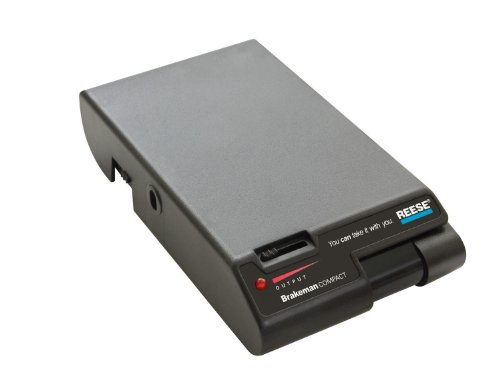 Reese Towpower Brakeman Timed Compact Brake Control 74642 | Check price on Amazon | |
 Hopkins Reliance Plug-in Simple Brake Control 47284 | Check price on Amazon |
How to Choose
A brake controller is a safety device first and a convenience device second. The right choice depends on trailer size, towing frequency, and what your tow vehicle already has wired. Check your trailer and vehicle manuals for axle counts, brake types, and wiring requirements before you buy.
Proportional or Time-Delayed Braking
Proportional controllers use an internal sensor to detect how quickly the tow vehicle is slowing down, then send a matching amount of power to the trailer brakes. Gentle braking up front means gentle braking at the trailer, while a firm stop produces a firmer trailer response. This gives smoother stops and less wear on both sets of brakes, which is why proportional controllers are often recommended for heavier trailers and frequent towing.
Time-delayed controllers work differently. When you press the brake pedal, the controller sends power to the trailer brakes after a short delay, ramping up to a preset level that you choose. They are simpler, usually easier to install, and often cost less than proportional models. The trade-off is that braking feel is less refined, because the trailer brakes apply at a fixed ramp rather than following the tow vehicle moment by moment. Time-delayed controllers suit lighter trailers, short trips, and drivers who tow only occasionally.
If you tow a travel trailer or a loaded utility trailer on a regular basis, a proportional controller is usually the better long-term choice. If you tow a small utility trailer a few times a year, a time-delayed controller can be entirely adequate.
Axle Capacity and Trailer Size
Check how many axles your trailer has and how many brakes it uses. Most controllers in this guide support trailers with one to four axles, but some models are limited to one or two axles, so do not assume every controller fits every trailer. The CURT Echo, for example, is designed for trailers with one or two axles, while the Tekonsha Prodigy P2 and the Brakeman models cover up to four axles.
Axle capacity is tied to the number of electric brakes the controller can power. A controller rated for fewer brakes than your trailer has may not deliver enough stopping power. Match the controller to the trailer you own now, and think about whether a larger trailer is likely in the next few years.
Display and Controls
A clear display makes a real difference when you are setting up a controller or checking for a fault on the road. Digital displays show output levels, gain settings, and diagnostic messages such as an overload or a short connection. Some controllers use a simple LED readout or a small screen, while others rely on a phone app for the display.
Manual override controls are also worth checking. A manual override lets you apply the trailer brakes on their own, without pressing the tow vehicle brake pedal, which is useful for correcting trailer sway and for testing the trailer brakes before a trip.
Installation and Wiring
Installation varies a great deal between models. Many wired controllers are plug-and-play when your tow vehicle already has a factory brake controller connector and you use the correct vehicle-specific wiring harness. In that case, installation can be a matter of plugging in the harness, mounting the unit, and setting the gain. If your vehicle has no factory connector, installation involves hardwiring, which takes more time and care.
Wireless controllers such as the CURT Echo avoid under-dash wiring altogether. The unit plugs into the seven-way connector at the rear of the tow vehicle, and you control it from a phone app, which makes it easy to move between vehicles.
Before you buy, confirm whether a wiring harness is included or sold separately. Some listings are for the controller alone, while others are kits that include a harness. The CURT Echo Kit in this guide, for example, is sold as a kit, so check exactly what is in the box before you order.
Compatibility With Your Vehicle
Not every controller works with every tow vehicle. Check compatibility with your vehicle year, make, and model, and with any factory towing package it already has. Some newer vehicles have integrated trailer brake controllers or specific wiring that can conflict with an aftermarket unit. Others need an adapter harness that is sold separately for that exact vehicle.
Electric-over-hydraulic brake systems are another compatibility point. If your trailer uses them, confirm that the controller you choose is rated for that system before you buy.
Boost, Gain, and Adjustment
Gain is the setting that controls how much power the controller sends to the trailer brakes. Too little gain and the trailer does not slow enough; too much and the trailer brakes grab or lock up. A good controller lets you adjust gain easily and remembers your setting between trips.
Some proportional controllers also offer boost settings, which add extra initial braking power for heavier loads. If you tow at very different weights from trip to trip, adjustable boost and gain let you tune the setup each time rather than settling for one fixed feel.
The Best Best Rated Brake Controller Reviewed
Tekonsha Prodigy P2 Electronic Brake Control 90885
The Tekonsha Prodigy P2 is a proportional brake controller built for drivers who tow regularly and want smooth, responsive braking. It uses an internal sensor to read the tow vehicle deceleration and applies the trailer brakes with matching force, so gentle stops stay gentle and firm stops get a firm trailer response. It is designed for trailers with one to four axles and works with electric brakes and electric-over-hydraulic systems.
Setup is straightforward, with a digital display that shows output, gain, and diagnostic messages. The unit is self-leveling, so it adjusts to changing terrain without manual leveling, and it includes a boost feature that lets you add extra braking power for heavier loads. A manual override lever sits within easy reach, which is useful for testing the trailer brakes and for correcting sway.
The Prodigy P2 also includes a plug-and-play connector that accepts a vehicle-specific wiring harness, which simplifies installation in vehicles that already have a factory brake controller plug. For drivers who tow a travel trailer or loaded utility trailer on a regular basis, the Prodigy P2 is a strong all-round choice that balances smooth braking, clear feedback, and broad axle coverage.
CURT Echo Kit Echo Mobile Trailer Brake Controller 51181
The CURT Echo Kit is a portable proportional brake controller that uses Bluetooth and a phone app instead of a fixed dashboard unit. It plugs into the seven-way connector at the rear of the tow vehicle, so there is no under-dash wiring to install and no permanent mount to fit. That makes it a practical choice for drivers who tow with more than one vehicle, rent trailers, or share a trailer between family members.
Through the app, you can adjust gain, set braking profiles, and view output and diagnostics on your phone. The unit provides proportional braking in both forward and reverse, and it stores multiple trailer profiles, so you can switch between trailers without redoing your settings each time.
One point to note: this listing is for the Echo Kit, which is a kit version of the Echo controller, so check the listing details to confirm exactly what is included in the box before you order. The Echo is rated for trailers with one or two axles, which covers many travel trailers and utility trailers, but it is not the right choice for a three or four axle trailer.
Tekonsha Brakeman IV Digital Brake Control 8507120
The Tekonsha Brakeman IV is a time-delayed brake controller for trailers with one to four axles. It is a simpler design than a proportional controller, and that simplicity is part of its appeal. When you press the brake pedal, the controller ramps power to the trailer brakes up to your chosen level, giving a predictable stop without the need for a motion sensor or complex setup.
A bright digital display shows the output setting, the sync setting, and diagnostic warnings for brake overload or a short connection, so you can see at a glance whether the system is working as expected. Installation is plug-and-play with the correct vehicle-specific wiring harness, and the unit can be mounted in a range of positions inside the cab.
The Brakeman IV suits drivers who tow lighter trailers, make short trips, or want a dependable controller without a long list of settings to learn. It is not as refined as a proportional controller under heavy braking, but for light to moderate towing it delivers steady, predictable control.
Reese Towpower Brakeman Timed Compact Brake Control 74642
The Reese Towpower Brakeman 74642 is a compact time-delayed brake controller for trailers with one to four axles. It takes a deliberately simple approach: a small plastic slider sets the braking level, and there is no screen or array of buttons to learn. The compact size means it can be fitted in tight spaces where a larger dashboard unit would be awkward, and installation is straightforward with the correct wiring.
Despite its basic appearance, the unit is anti-lock compatible and supports two, four, six, and eight brake systems, which covers a wide range of trailers. The time-based design ramps braking power in a predictable way, and the simple controls make it easy to adjust on the move. It is a good fit for occasional towing, small utility trailers, and drivers who prefer a no-fuss controller over a feature-heavy one.
The trade-off for that simplicity is a lack of detailed feedback. There is no digital display showing output levels or diagnostics, so you rely on feel and on the slider position rather than a readout. For heavier trailers or frequent towing, a proportional model with a display gives more control and feedback.
Hopkins Reliance Plug-in Simple Brake Control 47284
The Hopkins Reliance 47284 is a time-based plug-in brake controller designed for easy setup and everyday use. It uses a digital LED display that shows the braking output as a share of full power, so you can see how much braking the trailer is receiving and adjust the setting with confidence. Installation needs no tools for the plug-in design, and the unit is easy to operate even for a first-time tower.
The controller supports trailers with one to four axles and uses a time-based control system that you set through the display. That makes it a practical choice for drivers who want a clear readout without a complex menu system, and for trailers that fall within the light to moderate range. The plug-and-play approach also means the unit can be moved or removed without a lengthy uninstall.
As with other time-delayed controllers, braking feel is less refined than a proportional model. The Reliance is best suited to occasional and moderate towing, where simple setup and a clear display matter more than advanced proportional sensing.
What to Check Before You Buy
Before you order, confirm your trailer axle count and brake count, and check whether your trailer uses standard electric brakes or an electric-over-hydraulic system. Then check your tow vehicle for a factory brake controller connector and find out which wiring harness fits your year, make, and model.
Next, decide between proportional and time-delayed braking based on trailer weight and how often you tow. Heavier trailers and frequent towing point toward proportional control, while lighter trailers and occasional trips are well served by a time-delayed unit. Think about where the controller will mount in your cab, whether you want a digital display or are happy with a phone app, and whether you need a manual override within easy reach.
Finally, check what is included in the listing. Some controllers ship alone, some ship as a kit with a harness, and some need a vehicle-specific harness bought separately. Confirm the axle range and the brake types supported before you order.
FAQ
Do I need a brake controller to tow a trailer?
In many places, a brake controller is required by law for trailers above a certain weight, and it is good practice for any trailer with electric brakes. The controller lets the trailer brakes work with the tow vehicle brakes, which shortens stopping distances and keeps the rig stable.
What is the difference between proportional and time-delayed brake controllers?
A proportional controller senses how hard the tow vehicle is braking and applies the trailer brakes with matching force, giving smoother stops. A time-delayed controller sends power to the trailer brakes on a preset ramp after you press the pedal. Proportional controllers are smoother and better for heavier trailers, while time-delayed controllers are simpler and often suit lighter trailers and occasional towing.
How many axles can these brake controllers handle?
Most of the controllers in this guide support trailers with one to four axles, but the CURT Echo is rated for one or two axles only. Always check the axle and brake count for the exact model you buy, and match it to your trailer rather than assuming every controller covers every trailer.
Can I install a brake controller myself?
Many wired controllers are plug-and-play when your vehicle has a factory brake controller connector and you use the correct vehicle-specific harness. Wireless models such as the CURT Echo plug into the seven-way connector and need no under-dash wiring. If your vehicle has no factory connector, installation involves hardwiring.
Can I use one brake controller with more than one vehicle?
Yes, in some cases. A wireless controller such as the CURT Echo can be moved between vehicles because it plugs into the seven-way connector and is controlled from a phone app. A wired controller can also be moved if you fit a second wiring harness in the other vehicle, but that takes more effort.
Bottom Line
The best rated brake controller is the one that fits your trailer, your tow vehicle, and the way you tow. For regular towing with a heavier trailer, the Tekonsha Prodigy P2 offers smooth proportional braking, a clear display, and coverage for up to four axles. For drivers who tow with more than one vehicle, the CURT Echo Kit adds portability and phone control within a one or two axle limit. For simpler needs, the Tekonsha Brakeman IV, the Reese Towpower Brakeman 74642, and the Hopkins Reliance 47284 each provide dependable time-delayed control. Match the controller to your axle count and braking style, confirm the wiring harness, and you will have a safer, steadier tow.
Disclosure: As an Amazon Associate, we may earn from qualifying purchases.
Related guides
More from Amazon
Programs that pair well with the guide above. Offers and eligibility are set by Amazon and may change.
Free shipping on eligible items, Prime Video and more. Eligible new members can start with a free trial.
Start a Prime free trialAd-free music streaming. Eligible new subscribers can start with a free trial.
Try Music Unlimited freeA Prime membership for ages 18-24 with a trial period. Eligibility is set by Amazon.
See Prime for Young AdultsAudiobooks and podcasts to listen to on the go. Eligible new members can start with a free trial.
Try Audible freeAs an Amazon Associate we earn from qualifying purchases.