Our Short List of 3

- Best for: Drivers who tow regularly, including heavy tandem-axle trailers, and want the most informative display.
- Specs:
- Brand: Tekonsha
- Model: 90195 Prodigy P3
- Type: Proportional
- Best for: Drivers who split towing between highway and off-road, and who want a clean, factory-style dash.
- Specs:
- Brand: REDARC
- Model: EBRH-ACCV3-NA
- Type: Proportional and user-controlled (dual mode)

- Best for: Occasional towers, multi-vehicle households, and anyone who cannot or will not wire an under-dash unit.
- Specs:
- Brand: CURT
- Model: 51180 Echo
- Type: Proportional
All 4 Picks at a Glance
| Product | Specs | Action |
|---|---|---|
| 1. Tekonsha Prodigy P3 Proportional Brake Controller (90195) |
| Check price on Amazon |
| 2. REDARC Tow-Pro Elite Electric Brake Controller (EBRH-ACCV3-NA) |
| Check price on Amazon |
| 3. CURT Echo Mobile Electric Trailer Brake Controller (51180) |
| Check price on Amazon |
 4. Tekonsha Primus IQ Proportional Brake Controller (90160) |
| Check price on Amazon |
A trailer brake controller is the small box that tells your trailer’s electric brakes how hard to work when you press the pedal, and it is the difference between a composed stop and a trailer pushing your truck toward the intersection. Choosing one comes down to how it senses braking, how many axles it can run, and how it installs in your vehicle.
This guide compares four well-established controllers across the main styles: two under-dash proportional units from Tekonsha, a dual-mode REDARC with a remote dash dial, and CURT’s Bluetooth controller that plugs into the 7-way socket with no wiring at all. Each listing states its braking type and axle range, and those details are reflected in the specs below so you can match a controller to your trailer and tow vehicle.
Our Top Picks
Top 3 picks at a glance
Quick Picks
As an Amazon Associate we earn from qualifying purchases.
| Product | Best for | Key spec from title |
|---|---|---|
| Tekonsha Prodigy P3 (90195) | All-round towing, 1-4 axles | Proportional control with LCD display |
| REDARC Tow-Pro Elite (EBRH-ACCV3-NA) | On-road and off-road towing | Dual braking modes: proportional and user-controlled |
| CURT Echo (51180) | No-install, multi-vehicle use | Bluetooth smartphone control, plugs into 7-way |
| Tekonsha Primus IQ (90160) | Straightforward value | Proportional control for 1-3 axles |
How to Choose
Proportional versus time-delayed control
Proportional controllers sense how hard the tow vehicle is braking, through an internal inertia sensor, and apply the trailer brakes in proportion, which gives smooth stops in traffic and on hills. Time-delayed controllers simply ramp up to a preset power level over a set time whenever the brake pedal is pressed, regardless of how gently or hard you brake. Proportional is the better default for most towing, and every controller in this guide is proportional; the REDARC adds a user-controlled mode that behaves like a manual, set-level system for off-road use.
Axle count and brake capacity
Controllers are rated by how many trailer axles, and therefore brake assemblies, they can power. A controller listed for 1 to 4 axles covers everything from a single-axle utility trailer to a large tandem-axle travel trailer and beyond, while a 1 to 3 axle rating suits most mid-size trailers. Count your trailer’s axles before buying, and if you tow more than one trailer, choose the controller that covers the largest one, because an undersized controller cannot be coaxed into running extra brakes.
Installation style and vehicle fit
Traditional controllers mount under the dash and connect through a vehicle-specific wiring harness, sold separately for the Tekonsha units here, or by hardwiring on older vehicles. Remote-head designs like the REDARC hide the main unit and leave only a small dial on the dash. At the other extreme, the CURT Echo needs no installation at all: it plugs into the 7-way socket and is controlled from a phone app, which suits borrowed trucks and fleets. Match the style to whether the controller will live in one truck or move between vehicles.
Displays, boost, and manual override
A clear display and a manual override lever or button matter in real towing: the override lets you apply only the trailer brakes to settle sway, and diagnostics warn you about connection faults before they become roadside problems. Boost settings, found on the Tekonsha models, let you increase initial braking for heavier trailers. Consider how you will reach the controls from the driver’s seat, because a controller you cannot adjust or override without looking down is a controller you will not use when it counts.
The 4 Best Options
1. Tekonsha Prodigy P3 Proportional Brake Controller (90195)
- Best for: Drivers who tow regularly, including heavy tandem-axle trailers, and want the most informative display.
- Specs:
- Brand: Tekonsha
- Model: 90195 Prodigy P3
- Type: Proportional
Drivers who tow regularly, including heavy tandem-axle trailers, and want the most informative display.
Budget for the vehicle-specific harness if your truck is not already wired for a plug-in controller.
The Prodigy P3 is the benchmark under-dash controller. It is a proportional unit covering trailers with 1 to 4 axles, with a color LCD display that shows voltage, diagnostics, and settings in plain language rather than codes. Multiple boost levels let you tune how assertively the trailer brakes lead, storable settings suit drivers who tow several trailers, and the manual lever gives instant trailer-only braking. The listing notes compatibility across Ford, GM, Chevy, Dodge, RAM, Toyota, and Jeep vehicles, with the vehicle-specific wiring harness sold separately for plug-and-play installation on equipped trucks.
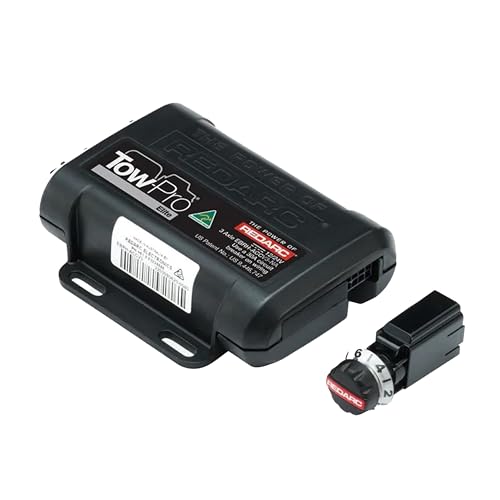
2. REDARC Tow-Pro Elite Electric Brake Controller (EBRH-ACCV3-NA)
- Best for: Drivers who split towing between highway and off-road, and who want a clean, factory-style dash.
- Specs:
- Brand: REDARC
- Model: EBRH-ACCV3-NA
- Type: Proportional and user-controlled (dual mode)
Drivers who split towing between highway and off-road, and who want a clean, factory-style dash.
It covers up to 3 axles, so very large multi-axle trailers need a higher-rated controller.
The Tow-Pro Elite does something no other controller here does: it offers two braking modes selected by a dash dial. Proportional mode handles highway towing in the usual smooth way, while user-controlled mode lets you set a fixed braking level for low-speed off-road work, steep descents, and slippery surfaces where inertia sensing is less useful. The main unit mounts out of sight, leaving only the compact remote dial visible, and the listing states universal fit for trailers with 1 to 3 axles and compatibility with both 12V and 24V vehicle systems.
3. CURT Echo Mobile Electric Trailer Brake Controller (51180)
- Best for: Occasional towers, multi-vehicle households, and anyone who cannot or will not wire an under-dash unit.
- Specs:
- Brand: CURT
- Model: 51180 Echo
- Type: Proportional
Occasional towers, multi-vehicle households, and anyone who cannot or will not wire an under-dash unit.
Control depends on your phone and the app, so keep the phone charged and mounted where you can reach the override safely.
The Echo removes installation from the equation entirely. The unit plugs inline into your vehicle’s 7-way trailer socket, the trailer plugs into it, and control happens through a Bluetooth connection to a smartphone app, where you adjust output and sensitivity and can trigger the manual override. Braking itself is proportional, using an internal sensor, and if the phone connection drops the controller continues with its last settings. It suits trailers with 1 to 2 axles and moves between vehicles in seconds, which makes it the natural pick for rentals, borrowed trucks, and second vehicles.
4. Tekonsha Primus IQ Proportional Brake Controller (90160)
- Best for: Drivers with one truck and a small to mid-size trailer who want proportional braking without paying for extras.
- Specs:
- Brand: Tekonsha
- Model: 90160 Primus IQ
- Type: Proportional
Drivers with one truck and a small to mid-size trailer who want proportional braking without paying for extras.
The display and feature set are simpler than the P3’s; heavy multi-trailer users will outgrow it.
The Primus IQ is Tekonsha’s straightforward proportional controller for trailers with 1 to 3 axles. It uses the same inertia-sensing proportional logic as its bigger siblings, with a digital display for output and diagnostics, a boost feature for heavier loads, and a snap-in dash mounting clip that lets you remove and store the unit when it is not needed. It works in reverse proportionally as well, which helps when backing a trailer down a ramp. For a single-truck, single-trailer setup that does not need the P3’s larger display and memory settings, it covers the essentials cleanly.
Which One Fits Your Situation
You tow a large travel trailer with your truck every season
The Prodigy P3 is the natural home base. Its 1 to 4 axle range covers big tandem trailers, the LCD diagnostics keep you informed on long drives, and stored settings mean the controller remembers your trailer’s tune. Wire it in once with the correct harness and it becomes part of the truck, ready every time you hitch up.
You tow off-road, on farms, or on steep loose surfaces
Choose the REDARC Tow-Pro Elite. The user-controlled mode is built for exactly the situations where proportional sensing struggles: crawling descents, mud, and gravel where you want a set, predictable level of trailer braking. The hidden install and small dash dial also suit newer trucks where a bulky under-dash box would look and feel out of place.
You borrow vehicles or tow only a few times a year
The CURT Echo was made for you. No wiring, no drilling, no permanent mount: plug it into the 7-way, pair the app, set your output, and tow. When the trip ends it comes off with the trailer and goes in the glovebox. Its 1 to 2 axle range matches the utility trailers, boat trailers, and small campers this pattern usually involves.
You want proven proportional control on a simple setup
The Primus IQ is the value route into the Tekonsha line. It gives you genuine proportional braking, boost, and diagnostics for trailers up to 3 axles, in a unit you can unclip and store. If your towing is one truck and one trailer, it delivers the safety-relevant parts of the P3 experience without the larger display and multi-trailer memory.
Common Mistakes
- Buying a controller rated for fewer axles than your trailer has; the rating is a hard electrical limit, not a suggestion.
- Forgetting the vehicle-specific wiring harness on under-dash controllers, then discovering the install is not plug-and-play on delivery day.
- Setting output once and never re-checking it after loading the trailer differently; braking needs change with load.
- Mounting a proportional controller loosely or at a wild angle without checking its mounting requirements, which can confuse the inertia sensor.
- Never practicing with the manual override, so the first time you reach for it is during real trailer sway at highway speed.
Frequently Asked Questions
Do I legally need a trailer brake controller?
In most US states, trailers above a certain weight, commonly around 3,000 pounds gross, must have their own brakes, and electric brakes only work with a controller in the tow vehicle. The exact threshold varies by state, so check your local rules. Even where not required, a controller dramatically improves stopping control with any trailer heavy enough to have electric brakes fitted.
What is the difference between proportional and time-delayed controllers?
A proportional controller measures how hard the tow vehicle is decelerating and matches the trailer braking to it, so gentle stops get gentle trailer braking and hard stops get full help. A time-delayed controller applies a preset amount of braking on a timed ramp whenever the pedal is pressed, regardless of urgency. Proportional control is smoother, easier on brakes, and preferred for regular towing.
Can one controller work with several trailers?
Yes, as long as every trailer is within the controller’s axle rating. Models like the Prodigy P3 store settings for different trailers, while simpler units like the Primus IQ need a quick output adjustment when you switch. The CURT Echo moves the other way: it stores its settings in the unit and app, so it can also move between tow vehicles without rewiring anything.
How do I set the braking power correctly?
With the trailer loaded as it will travel, drive at low speed on a flat surface and apply the manual override: the trailer brakes should engage firmly without locking the wheels or feeling absent. Then make a few normal stops and adjust output or boost until the truck and trailer slow together without the trailer pushing or dragging. Re-check whenever the load changes significantly, and consult the controller’s manual for its specific procedure.
Related guides
More from Amazon
Programs that pair well with the guide above. Offers and eligibility are set by Amazon and may change.
Free shipping on eligible items, Prime Video and more. Eligible new members can start with a free trial.
Start a Prime free trialAd-free music streaming. Eligible new subscribers can start with a free trial.
Try Music Unlimited freeA Prime membership for ages 18-24 with a trial period. Eligibility is set by Amazon.
See Prime for Young AdultsAudiobooks and podcasts to listen to on the go. Eligible new members can start with a free trial.
Try Audible freeAs an Amazon Associate we earn from qualifying purchases.