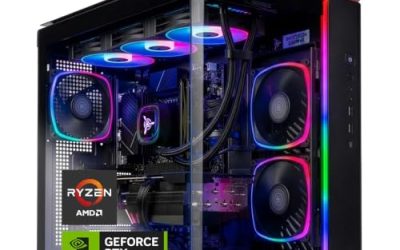
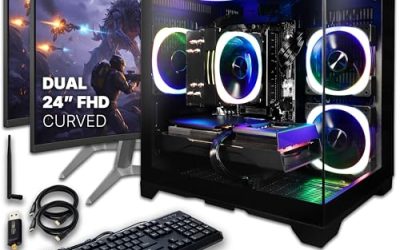
Under 2000 dollars is the budget where a prebuilt gaming PC stops being a compromise and becomes a decision about where to put the strength. The graphics card ladder forks here: one branch offers a lower-tier card with a large pool of video memory, the other a higher-tier card with a smaller pool, and the rest of the build shifts around that choice. Add the processor family, the memory type, the power supply and the cooler, and two listings with almost the same headline price can behave very differently in a year.
This guide is for players aiming at smooth high-detail 1080p and 1440p gaming in 2026, for upgraders replacing a card-limited older tower, and for anyone who would rather buy a finished machine than source parts. It reviews seven prebuilts using only the facts stated in their titles, so use it to shortlist, then confirm the motherboard, case and warranty on each product page.
Our Top Picks
 iBUYPOWER Element Gaming PC Desktop Computer AMD Ryzen20 x 9.1 x 17.4 inches36 poundsCheck on Amazon




Top 3 picks at a glance
Quick Picks
As an Amazon Associate we earn from qualifying purchases at no extra cost to you.




| Product | Best for | Key spec taken from the title |
|---|---|---|
| msi Codex Z2 | Storage-heavy libraries | Ryzen 7 8700F, RTX 5070, 32GB DDR5, 2TB SSD |
| iBUYPOWER Element | Processor-heavy gaming and creation | Ryzen 9 7900X, RTX 5070 12GB, 32GB DDR5, 1TB NVMe |
| CyberPowerPC Gamer Master | Straightforward 1080p play | Ryzen 7 8700F, RTX 5060 Ti 8GB, 16GB DDR5, 1TB PCIe 4.0 |
| ZOTAC MEK | Video memory and power headroom | Ryzen 7 9700X, RTX 5060 Ti 16GB, 32GB DDR5, 850W 80+ Gold |
| YAWYORE Ryzen 7 5700X | Tight budgets with big memory | Ryzen 7 5700X, RTX 5060, 32GB DDR4, 1TB M.2 NVMe |
| KOTIN RTX 5070 with display | Cooling and monitoring features | RTX 5070 12GB, Ryzen 7 9700X, 360mm liquid cooler, 850W Gold |
| Alienware Aurora | Intel build with premium networking | RTX 5070, Core Ultra 7 265F, 32GB DDR5, Wi-Fi 7, 2.5Gb Ethernet |
The 7 Best Options
msi Codex Z2 with Ryzen 7 8700F and RTX 5070
The msi Codex Z2 is the pick for players with a big game library and no wish to juggle drives. The title lists an AMD Ryzen 7 8700F, a GeForce RTX 5070, 32GB of DDR5, a 2TB SSD, a USB Type-C port, VR-ready labeling and Windows 11 Home. Pairing a higher-tier graphics card with 32GB of memory and a drive twice the size of most rivals makes the listing feel finished rather than stripped to hit a number. A recognizable brand name also tends to mean a clearer warranty process than a boutique seller. The USB Type-C port is a small convenience for phones, headsets and fast external drives, and the VR-ready tag suggests the seller expects the machine to be paired with a headset. Titles that run long usually bury the power supply and cooler, so buyers should treat the missing details as questions to answer before checkout rather than assuming the best.
- 2TB of storage fits many large installs without an immediate second drive
- RTX 5070 graphics sit in the higher tier of the group
- 32GB of DDR5 is comfortable for gaming plus background apps
- The Ryzen 7 8700F is a mainstream processor next to the Ryzen 9 in the iBUYPOWER
- The truncated title says little about the power supply or cooling, so those need checking
Skip it if you edit video or render projects heavily and want the strongest processor. Against the iBUYPOWER that follows, the msi gives you more storage while the iBUYPOWER gives you a more powerful processor, so the question is whether your bottleneck is games or CPU-heavy tasks. The VR-ready wording is a nice extra for headset owners, though it is only a label and not a guarantee of any specific experience. Its 2TB drive is the single most practical difference between the two RTX 5070 machines for someone who installs several large games at once.
iBUYPOWER Element with Ryzen 9 7900X and RTX 5070
The iBUYPOWER Element puts the processor first. Its title names an AMD Ryzen 9 7900X, a GeForce RTX 5070 with 12GB, 32GB of DDR5, a 1TB NVMe SSD and Windows 11 Home. A Ryzen 9 is a rare sight in a prebuilt aimed at gamers, and it signals that the seller expects the machine to double as a creation workstation for video, streaming or code compiling. The 12GB of video memory attached to the RTX 5070 is stated outright, which helps when comparing against the 16GB ZOTAC. Because the listing names the exact processor model, buyers can look up its cooling requirements before deciding whether the unnamed cooler is up to the job. The Windows 11 Home license is listed, so the machine should be ready to use after the first-boot setup screens.
- Ryzen 9 7900X is the strongest processor named anywhere in this roundup
- 12GB of video memory is stated for the RTX 5070
- 32GB of DDR5 and an NVMe drive cover both gaming and creative software
- 1TB of storage is half the msi, so a second drive may be needed sooner
- High-end Ryzen 9 chips run warm, and the title does not state the cooler or power supply
Skip it if you only play games and would rather spend on storage. Compared with the CyberPowerPC next, the iBUYPOWER steps up one tier in both the card and the processor, which is the largest jump in the first half of this list. If you stream, record and play together, the extra cores may matter more than any other spec here. For a pure gamer, the same money often goes further on the 2TB msi, so decide honestly how much creative work the machine will actually do.
CyberPowerPC Gamer Master with Ryzen 7 8700F and RTX 5060 Ti
The CyberPowerPC Gamer Master is the plain, sensible choice. The listing mentions a Ryzen 7 8700F, a GeForce RTX 5060 Ti with 8GB, 16GB of DDR5, a 1TB PCIe 4.0 SSD, WiFi readiness and Windows 11 Home. Nothing here is exotic, which is a feature for buyers who want a conventional build from a long-established prebuilt maker with an easy support path. The WiFi Ready wording is worth reading carefully, since it can mean the board supports a wireless card rather than ships with one installed, and a wired connection avoids the question entirely. For a first prebuilt, the predictable layout and simple upgrade story count for more than a long list of extras. Buyers who mostly play at 1080p will find the specs well matched to their goal.
- DDR5 memory and a PCIe 4.0 SSD are stated, giving a modern platform
- RTX 5060 Ti graphics suit smooth 1080p and capable 1440p play
- Established brand with a straightforward warranty route
- 16GB of memory is adequate today but is the first thing to upgrade
- 8GB of video memory limits the longevity of high-detail texture settings
Skip it if you want future-proofing for newer releases, as the 8GB card is the weak link for the next few years. Against the ZOTAC that follows, you save on memory, video memory and power supply, so only pick it if the ceiling is firm and the gaming target is 1080p. If you expect to keep the machine for several years, the 16GB ZOTAC is the safer long-term bet.
ZOTAC MEK with Ryzen 7 9700X and RTX 5060 Ti 16GB
The ZOTAC MEK is the headroom pick. The title lists a Ryzen 7 9700X, a GeForce RTX 5060 Ti with 16GB, 32GB of DDR5, a 1TB NVMe SSD, an 850W 80+ Gold power supply, WiFi 6E and Windows 11 Home. Sixteen gigabytes of video memory is unusually large for the tier and helps with texture-heavy games and creative software that fill the card. The WiFi 6E mention is a modern wireless standard, and the Gold-tier power supply suggests the builder sized the system with some care. A Ryzen 7 9700X is a newer-generation chip than the 8700F that appears in the msi and CyberPowerPC listings, so the platform has a slightly longer runway. This build rewards players who care about longevity over the last few frames per second.
- 16GB of video memory gives room for high-detail textures
- An 850W 80+ Gold power supply is stated, leaving room for upgrades
- Current-generation Ryzen 7 9700X with 32GB of DDR5
- The graphics card is a lower tier than the RTX 5070 models in this guide
- 1TB of storage is modest next to the msi
Skip it if raw frame-rate potential matters more than video memory. Compared with the YAWYORE below it uses the newer DDR5 platform, and compared with the KOTIN 5070 it trades graphics tier for memory capacity on the card. A brand with a long history in graphics hardware is also a small plus for buyers who value familiarity. If your library is full of heavily modded titles, the extra video memory is the feature most likely to save you from texture stutter later.
YAWYORE Ryzen 7 5700X with RTX 5060
The YAWYORE is the lean build. It names a Ryzen 7 5700X, a GeForce RTX 5060, 32GB of DDR4, a 1TB M.2 NVMe SSD, ARGB fans, WiFi and Bluetooth. At a budget of under 2000 dollars it leaves the most money unspent, which is a virtue for anyone who intends to buy a monitor, chair or headset with the savings. The Ryzen 7 5700X is an older AM4 processor, so the platform will not receive newer chip generations, but it is a capable eight-core part for games. The 32GB of DDR4 is the standout, and it is a rare sight in a build that leaves so much of the budget unspent. Buyers should confirm the power supply and case details, since the title says only ARGB fans.
- 32GB of DDR4 matches the memory of far more expensive builds
- NVMe storage and Wi-Fi with Bluetooth cover the basics
- A sensible all-rounder for 1080p play
- DDR4 and an older platform limit long-term upgrades
- The RTX 5060 sits below the 5060 Ti and 5070 cards in this list
Skip it if you want the best possible platform longevity. It is the value outlier in the roundup, and the step up to the CyberPowerPC buys DDR5 and a faster card tier for a modest premium. For a player on a 1080p monitor this lean build is a legitimate choice, not just a compromise.
KOTIN RTX 5070 with Ryzen 7 9700X and Smart Display
The KOTIN RTX 5070 build is the feature-rich option. The title lists an RTX 5070 with 12GB, a Ryzen 7 9700X, 32GB of DDR5, a 1TB SSD, an 11.3in smart display, an 850W 80+ Gold power supply, a 360mm liquid cooler and WiFi 7. The display shows system information on the case, which suits buyers who like to monitor temperatures at a glance. The pairing of a 360mm liquid cooler with an 850W Gold supply is more complete than many listings in this range provide, and the Ryzen 7 9700X is a current-generation processor. WiFi 7 is the newest wireless standard, though it only pays off with a compatible router. Buyers should look at the warranty terms for the pump and display, since those parts add more things that can fail.
- RTX 5070 graphics with 12GB, matched to a current Ryzen 7 9700X
- 360mm liquid cooler and 850W Gold supply are both stated
- WiFi 7 and 32GB of DDR5 round out a modern platform
- A smart display adds a feature that does not improve frame rates
- Liquid cooling adds a pump that is another component to monitor over time
Skip it if you prefer proven brand support over feature count. Against the Alienware that follows, this build offers more cooling and a stated power supply, while the Alienware offers a recognizable name and premium networking. Compared with the plain air-cooled builds above, this one has a cooling-first personality and a look that suits a desk where the case is visible.
Alienware Aurora with Core Ultra 7 265F and RTX 5070
The Alienware Aurora is the Intel option. The title mentions an RTX 5070, an Intel Core Ultra 7 265F, a 1TB SSD, 32GB of DDR5, Wi-Fi 7, Bluetooth, Killer 2.5Gb Ethernet and Windows 11 Home. Wired and wireless networking are both strong here, which suits competitive players who care about latency and consistency. The Core Ultra 7 265F is an Intel desktop processor with no integrated graphics, so the RTX card is essential. Alienware cases and boards are designed around the brand, which gives a polished look and a tidy interior but narrows your choices for replacement parts. Buyers who want a clean, ready-to-play machine with strong networking will find that trade-off acceptable.
- RTX 5070 graphics paired with 32GB of DDR5
- Wi-Fi 7 and 2.5Gb Ethernet cover both wired and wireless setups
- A well-known brand with an established support network
- Branded cases can limit part compatibility if you upgrade later
- The title does not state the power supply wattage or cooler type
Skip it if you want a standard case and easily swapped parts. It closes the list as the polished Intel pick, and if you value upgradability above brand identity, the msi or ZOTAC is the more conventional choice. For an Intel buyer who prizes a recognizable name and premium network hardware, this is the clearest fit in the group.
Why Buy a Prebuilt Gaming PC at This Budget
You get a matched system and one warranty
At this price a prebuilt arrives with the compatibility questions already answered: the motherboard fits the processor, the power supply handles the card, and the cooler fits the case. If something fails, there is one seller to call instead of five manufacturers to chase. That peace of mind is worth real money for first-time buyers, and it removes the risk of mismatched parts, bent pins or a forgotten cable that can ruin a first build weekend.
The graphics card is the part you actually pay for
Shoppers sometimes forget that a graphics card is the main reason a gaming PC feels fast. Listings in this range center on RTX 5060, 5060 Ti and 5070 cards, and the card name in the title tells you more about gaming potential than the processor or the lighting. Treat a vague mention of RTX graphics as a warning sign, because the exact model separates a capable machine from a weak one.
The rest of the build decides how long it lasts
A good card in a thin build gets stuck. Memory, storage, cooling and power headroom determine whether the machine stays useful for a handful of years, and the listings that state their wattage and cooler type are easier to trust. A prebuilt that spends on a strong card but skimps on the power supply or airflow tends to run hot and loud, and that wears on enjoyment long before it affects the numbers buyers like to quote.
How to Choose
Graphics card tier and video memory
For smooth 1440p play, look for an RTX 5060 Ti or higher with at least 12GB of video memory if you can afford it. An 8GB card handles 1080p well, but newer titles at high texture settings can exceed it. Ignore marketing terms and read the exact card name and memory in the title. Resolution is the other half of the question: a card that is comfortable at 1080p may need lowered settings at 1440p, and a 4K monitor is a different budget conversation altogether. Upscaling features such as DLSS 4 are helpful, but they work best when the card has enough native performance to begin with, so they should not be the deciding factor on their own.
Processor choice and core count
Eight cores is the comfortable target for a gaming PC that also runs streaming or chat software. Ryzen 7 8700F and 9700X models fit that target, while a Ryzen 9 adds more cores for creative work. Check that the processor generation matches the memory type, because AM5 platforms use DDR5. Do not pay extra for a higher core count unless you stream, edit or compile code, because games rarely use more than eight cores well. An F-series chip has no integrated graphics, which is fine as long as the discrete card is working.
Memory capacity and type
Sixteen gigabytes of DDR5 is fine for gaming alone, but 32GB is the more future-proof choice and leaves room for a browser and chat. DDR4 builds can still be competitive at this budget, though they sit on an older platform with a narrower upgrade path. Memory speed matters less than capacity and channel layout, so a two-stick kit is preferable to a single large module.
SSD capacity and interface
One terabyte of NVMe storage fills quickly with modern installs, so 2TB is a real advantage. PCIe 4.0 is the sensible interface at this tier. Avoid builds that rely on a small boot drive plus a mechanical disk for games. Budget prebuilts sometimes cut corners with a slower drive whose speed falls once its cache fills, so a named interface is a good sign.
Power supply and cooling
An 850W 80+ Gold supply, as stated on the ZOTAC and KOTIN, gives comfortable headroom for the card and later upgrades, while a 550W to 650W unit is workable for a mid-range card but leaves little margin. Efficiency tiers such as Gold also signal that the builder chose a supply with some care. A 360mm liquid cooler suits warmer processors, while air cooling is fine for efficient models. Listings that hide wattage and cooler details deserve a closer look before purchase. Aggressive overclocking claims on a stock prebuilt are rarely worth the heat and noise.
Case, ports, networking and warranty
Count the front-panel USB ports and check for USB Type-C. A tower with a mesh front panel and several fans usually runs cooler than one with a solid glass front, so airflow is worth a second look in photos. Wi-Fi 6E or Wi-Fi 7 helps if you cannot run a cable. Ignore decorative extras such as lighting counts. Read the warranty period, because boutique builders vary widely in how long they cover parts and labor. Also check how returns work if the machine arrives damaged, since heavy towers can suffer in transit.
RTX 5070 or RTX 5060 Ti 16GB
This is the choice most buyers at this budget face, and the titles in this list let you compare it directly. The two cards come from different tiers, and the difference is about what each one spends its silicon on: more raw graphics speed in one case, more memory in the other.
| Factor | RTX 5070 12GB builds | RTX 5060 Ti 16GB build |
|---|---|---|
| Graphics tier | Higher-tier card | Lower-tier card |
| Video memory | 12GB listed | 16GB listed |
| Examples here | iBUYPOWER, KOTIN, msi, Alienware | ZOTAC MEK |
| Best for | Higher frame rates at 1440p | Texture-heavy and creative workloads |
When the RTX 5070 wins
If your main goal is high frame rates in current games, the higher-tier 5070 is the stronger pick. It is the card behind most of the premium listings in this guide, and its tier advantage generally matters more than extra memory for games. Pair it with a quick processor and a 1440p monitor and the extra frame rate shows up in everyday play, not just in charts. The cost is that 12GB can feel tight if you push every texture slider to maximum in the newest releases.
When the 5060 Ti 16GB wins
The 16GB card suits players who mod games, use high-resolution textures or run creative software that fills video memory. It also pairs with a generous power supply on the ZOTAC, which makes it a practical long-term platform. It also suits buyers who plan to try local AI tools or large-texture creative software, where video memory capacity can matter as much as raw speed.
Setup, Compatibility and Upgrade Tips
What to check before buying
Open the full listing and confirm the power supply wattage, the cooler type and the motherboard chipset. If the seller lists a model number, search for the full specification sheet, because prebuilt names often hide the exact motherboard and supply. Verify the number of memory slots in use, because a 32GB kit in two sticks leaves room to grow. Check whether the case has dust filters and room for extra drives. Look at the rear ports as well, because a high-refresh monitor needs a modern DisplayPort or HDMI output, and note whether the box includes a keyboard, mouse and Wi-Fi antenna.
What to upgrade first
On 16GB systems, add memory first. After that, a second NVMe drive is the cheapest quality-of-life upgrade. Leave the processor and graphics card alone until the platform proves limiting. A good monitor and a quality headset improve the day-to-day experience more than a small component swap.
Common compatibility traps
Branded cases and proprietary power supplies, found in some name-brand prebuilts, can restrict upgrades. DDR5 and DDR4 are not interchangeable. Long cards need case clearance, and liquid radiators need compatible mounts. A card with a high power draw may need a specific connector from the supply, so confirm that the cables exist before planning a graphics upgrade. Confirm that Windows is activated on first boot. Finally, update the graphics driver and motherboard firmware right away, because prebuilts can ship with older versions than the current releases.
Which One Fits Your Situation
A player with a huge Steam library
The msi Codex Z2 is the fit, thanks to its 2TB SSD and RTX 5070 graphics. The drive alone saves you a second purchase, and the 32GB of DDR5 keeps the rest of the system comfortable.
A streamer who also edits video
The iBUYPOWER Element suits this mix, since the Ryzen 9 7900X provides the processor strength creation work uses. If recording and editing are occasional, the msi is the simpler alternative.
A texture-hungry modder on a firm budget
The ZOTAC MEK is the practical answer, with 16GB of video memory and a stated 850W Gold power supply. It also leaves room to add storage or a more demanding card later without replacing the supply.
A shopper who wants maximum value and a monitor upgrade fund
The YAWYORE keeps the cost down while still offering 32GB of memory and NVMe storage. Put the savings into a good monitor and you may end up with a better overall setup than a pricier box with a weaker screen.
Common Mistakes
- Choosing by processor name and ignoring the graphics card, which decides most of the gaming experience in the titles people actually play.
- Overlooking the power supply wattage and efficiency tier when a listing does not state them.
- Buying 16GB of memory and assuming it will remain enough for several years.
- Assuming every prebuilt case and power supply accepts standard upgrades, which is not true of some branded designs.
- Paying for lighting and displays instead of storage and cooling.
- Skipping the warranty length and return window on lesser-known brands.
Related guides
- How To Clean Quest 3 Lenses And Facial Interface
- Vr Facial Interfaces For Glasses Wearers
- Micro Sd Cards For Samsung Galaxy Phones
Frequently Asked Questions
Is an RTX 5070 enough for 1440p gaming?
The RTX 5070 is a higher-tier card aimed at strong 1440p play in current games. Settings and results depend on the title, so check the specific games you care about and the resolution of your monitor.
Is 16GB of RAM enough for a gaming PC under 2000 dollars?
It is enough for gaming today, but 32GB gives more room for background apps and longer-term use. Several listings here include 32GB, so there is little reason to settle for less unless the budget is tight.
Does 16GB of video memory matter?
It helps in texture-heavy games and creative software. For most games at 1080p or 1440p, the card tier matters more.
Should I choose DDR5 over DDR4?
DDR5 sits on the newer platform and offers a better upgrade path. DDR4 builds can still deliver good gaming at a lower overall spend.
Is liquid cooling better than air cooling?
Liquid cooling helps with warmer processors and quiet operation, while good air cooling is simpler and has no pump to fail. Match the cooler to the processor in the listing, and read the warranty on the pump if one is included.
Are name-brand prebuilts worth it?
They offer clearer support and polished designs, though proprietary parts can limit upgrades. Smaller sellers often include more standard components, and either route can work if the warranty terms are clear.
Final Words
The right gaming PC under 2000 dollars is the one that puts the strength where your games need it. Choose an RTX 5070 build for frame rates, a 16GB card for textures and creation, or a lean DDR4 build when savings matter more than longevity. Confirm the power supply, cooling and warranty on the product page before ordering, and plan to add memory or storage as your library grows. A balanced build with room to upgrade will outlast a flashy one with a single strong part.