D cells are the heavy lifters of the battery world: baby swings, big flashlights, lanterns, boomboxes, and toy trucks that eat through disposables in a weekend. Switching them to rechargeable makes financial sense quickly, but D-size rechargeables come in two very different flavors. One is nickel-metal hydride at 1.2 volts, usually with big milliamp-hour figures. The other is lithium-ion at a regulated 1.5 volts, measured in milliwatt-hours and often charged through a USB-C port. Which type you pick changes how it behaves in your device.
This guide looks at seven rechargeable D options for 2026 and focuses on that decision. If your gadget is sensitive to voltage, such as a radio or a motorized toy that slows down as cells sag, you may prefer the 1.5 volt lithium cells. If you already own a charger and want the cheapest long-term cost per cycle, NiMH may be the right call. The sections below explain the numbers so you can choose without guessing.
Our Top Picks
Top 3 picks at a glance
Quick Picks
As an Amazon Associate we earn from qualifying purchases at no extra cost to you.




| Product | Best for | Key spec from the title |
|---|---|---|
| Energizer Recharge Universal D (2 Pack) | A small, brand-name starter | Universal rechargeable D, 2 pack |
| Artman Lithium D (4 Pack) | USB-C charging, steady 1.5V output | 9000mWh, 1.5V, 2-in-1 USB-C cable |
| RayHom NiMH D (4 Pack) | Buyers who want a charger in the box | 10000mAh, 4 slot charger, low self-discharge |
| EBL NiMH D (4 Pack) | One charger for AA, AAA, C, and D | 1.2V, 10000mAh, LCD smart charger |
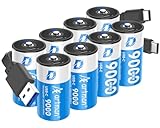
| Artman Lithium D (8 Pack) | Households with many D devices | 9000mWh, 1.5V, four 2-in-1 USB-C cables |
| BONAI NiMH D | Baby swings, flashlights, and toys | 10,000mAh, 1.2V, pre-charged |
| ENEGON Lithium D (4 Pack) | Highest listed energy with a display | 12580mWh, 1.5V, 500+ cycles, touch power display |
How to Choose
NiMH or lithium: voltage is the first fork
NiMH D cells output 1.2 volts, slightly below the 1.5 volts of an alkaline. Most devices run fine on 1.2 volts, but some, especially older radios and battery-powered toys with simple circuits, may run slower or report a low battery earlier. Lithium-ion D cells in this guide are labeled 1.5 volts, which keeps devices closer to their expected voltage for most of the discharge. The trade-off is that lithium cells need their own USB-C charging setup, while NiMH cells usually charge in a standard slot charger.
Reading the capacity numbers correctly
The NiMH listings quote milliamp-hours, such as 10000mAh. The lithium listings quote milliwatt-hours, such as 9000mWh or 12580mWh. To compare, multiply milliamp-hours by voltage: 10000mAh at 1.2 volts is about 12000mWh on paper. That puts the NiMH and lithium capacities in the same ballpark, so the listed figures should be treated as headline numbers, not guarantees. Large D-size capacity claims vary a lot between brands, and real device run time depends on the draw.
A baby swing, for example, might draw gently for hours, while a bright lantern or a toy with a motor draws hard in bursts. Heavy loads shorten run time more than the headline number suggests, so buyers who care about long sessions should favor the larger listed capacity and keep a spare set charged.
Charger and cable compatibility
Check what is in the box. Some packs include a slot charger, such as the four-slot unit in the RayHom or the LCD smart charger in the EBL. The Artman and ENEGON lithium cells are described with USB-C charging, which means you need a USB power source, but you may not need a separate charger. Make sure any charger you use matches the chemistry. Charging NiMH cells in a lithium charger, or the reverse, is both ineffective and unsafe.
Cycle life, self-discharge, and where budget cells cut corners
The ENEGON title claims 500 or more cycles, while the RayHom mentions low self-discharge, meaning it should keep much of its charge on a shelf. Budget no-name cells sometimes quote very large capacities that do not hold up in daily use, or lose charge quickly when idle. If a device sits in a closet for months, prioritize low self-discharge and a pre-charged label. Ignore terms like “ultra” or “super” when no number backs them up.
Another practical point is physical fit. D cells are large, and some lithium designs are built with slightly different dimensions or a flatter terminal than an alkaline D. Most devices accept them, but a tight battery tray or a spring-loaded contact can be fussy. Read the compatibility notes and check any warranty or return policy before relying on a pack for an important device.
The 7 Best Options
Energizer Recharge Universal D (2 Pack)
The Energizer pack is the simplest option: two rechargeable D cells from a familiar brand. It suits someone who needs just a pair for a lantern or a radio and prefers a recognized name to a big count. Typical buyers are people with a camping lantern, a portable radio, or a workshop flashlight who want to stop buying disposables but do not want to commit to a large, unfamiliar system with extra cables and gadgets to track.
- Strength: Brand-name option in a small quantity.
- Strength: “Universal” labeling suggests compatibility with common chargers.
- Trade-off: Only two cells, so devices that take four or more need a bigger pack.
Skip it if you need to power a multi-cell device.
Artman Lithium D (4 Pack)
Artman offers 1.5 volt lithium-ion D cells at 9000mWh with a 2-in-1 USB-C charging cable. It fits buyers who want steady voltage and the convenience of charging from a USB port, with no separate charger. It is a good match for a parent with a baby swing or a hobbyist with a pair of high-draw lights, where steady voltage matters and a wall adapter or power bank is always nearby for a quick top-up.
- Strength: 1.5 volt output keeps voltage-sensitive devices happy.
- Strength: USB-C charging with a single cable.
- Trade-off: Listed energy trails the highest figures in this group.
Skip it if you prefer the classic drop-in slot charger.
RayHom 10000mAh NiMH D (4 Pack)
RayHom bundles four NiMH D cells with a four-slot magnetic charger and emphasizes low self-discharge. The package is aimed at buyers who want a ready-to-go system. Someone replacing a drawer of disposable cells with a single rechargeable set for toys, emergency lights, and a portable fan would find the included charger removes a shopping step and makes the first charge straightforward.
- Strength: Charger included in the box.
- Strength: Low self-discharge supports shelf storage.
- Trade-off: 1.2 volts may run some voltage-sensitive devices differently.
Skip it if you already own a good charger.
EBL 10000mAh NiMH D (4 Pack)
EBL pairs four 1.2 volt NiMH D cells with an LCD smart charger that handles Ni-MH AA, AAA, C, and D. For a household that wants one charger for all common sizes, it is a flexible choice. The charger also means the same unit can look after your AA remotes and C-cell gear, which is helpful for a household that is slowly converting its whole battery drawer to rechargeable cells over time.
- Strength: LCD charger covers several battery sizes.
- Strength: High listed capacity for a four-pack.
- Trade-off: Lower voltage than lithium D cells.
Skip it if you want USB-C charging for travel.
Artman Lithium D (8 Pack)
The eight-pack takes the Artman concept to larger households, with four 2-in-1 USB-C charging cables and 1.5 volt output. It covers two four-cell devices or a full rotation of spare sets. Families with multiple baby swings, bouncers, or music players, as well as small workshops with several lanterns, can keep one group in use while the other group charges overnight over USB.
- Strength: Eight cells with included cables for simultaneous charging.
- Strength: 1.5 volt regulated output.
- Trade-off: Large purchase for someone with only one D device.
Skip it if your needs are modest.
BONAI 10,000mAh NiMH D
BONAI targets baby swings, flashlights, and toys with 1.2 volt NiMH cells that come pre-charged. It is a practical choice if you want to start using the cells right away. A caregiver who is tired of swapping disposables in a swing every few days, or a camper packing a flashlight for a long weekend, will see the point of having a ready set that can be recharged and reused.
- Strength: Pre-charged for immediate use.
- Strength: Positioned for common household D devices.
- Trade-off: Title does not specify a charger, so check what is included.
Skip it if you want an all-in-one charging kit.
ENEGON Lithium D (4 Pack)
ENEGON advertises 12580mWh, USB-C charging, a touch power display, and 500 or more cycles. It leads the lithium group in listed energy and adds a display for checking charge level. For someone who wants to know at a glance whether the cells are ready before heading out, or who runs a power-hungry flashlight, that readout is a practical convenience rather than a gimmick.
- Strength: Highest listed energy among the lithium options.
- Strength: Touch power display for quick status checks.
- Trade-off: Lithium cells depend on USB-C charging rather than a drop-in slot charger.
Skip it if you prefer familiar NiMH chemistry.
Which One Fits Your Situation
You own a baby swing or a toy that is picky about voltage
Try Artman or ENEGON lithium cells with their 1.5 volt output. They are closer to alkaline voltage and may keep the motor speed more consistent. If the device has an electronic low-battery warning, that steadier voltage can also prevent false alarms partway through a nap.
You want everything in one box
The RayHom set with its four-slot charger is the most complete package, while the EBL pairs cells with a multi-size LCD charger.
You need only two for a lantern
Choose the Energizer Recharge Universal two-pack. It keeps the purchase small and uses a recognized name. Confirm that you have a charger that accepts D-size cells, since a two-pack on its own will not help if your existing charger only handles AA and AAA.
You run several D devices at once
The Artman eight-pack is built for this. You can charge spare cells while others are in use, and the multiple cables mean you are not waiting in line at a single charger. The BONAI is a lower-key alternative if your devices tolerate 1.2 volt cells.
Common Mistakes
- Putting NiMH cells in a charger meant for lithium, or the reverse.
- Comparing mAh and mWh numbers without converting for voltage.
- Assuming 1.2 volt cells will behave exactly like alkaline in every device.
- Ignoring self-discharge for devices that sit unused.
- Buying an eight-pack when the device only takes two cells.
Related guides
- How To Clean Quest 3 Lenses And Facial Interface
- Vr Facial Interfaces For Glasses Wearers
- Micro Sd Cards For Samsung Galaxy Phones
Frequently Asked Questions
Are rechargeable D batteries worth it?
For high-drain, frequently used devices, yes. They pay back after enough cycles compared with disposables, especially in swings and toys.
Can I use NiMH D cells in any device?
Most devices accept them, but a few voltage-sensitive ones may show a low-battery warning early because of the lower 1.2 volt output.
How do I charge lithium D cells?
The Artman and ENEGON listings describe USB-C charging. Use a compatible USB power source and the cable provided.
What happens if I leave cells unused for months?
NiMH cells slowly lose charge. Look for low self-discharge labeling and top them off before use.