Our Top Picks
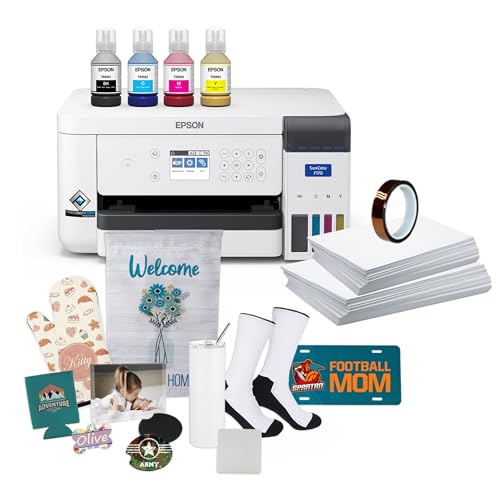 Epson SureColor F170 Dye-Sublimation Printer. Includes Full SetSCF17013.7 x 14.8 x 7.4 inchesCheck on Amazon
 Brother SP-1 Sublimation Printer Starter Bundle with Full17" x 13.5" x 7"17 x 13.5 x 6.3 inchesCheck on Amazon

Top 3 picks at a glance
Best Sublimation Printers for Beginners: What to Buy First
The best sublimation printers for beginners are dye-sub converted 13×19-inch photo printers — the Epson SureColor F170 is the simplest all-in-one starting point at roughly $400–$500, while the Sawgrass Virtuoso SG500 is the better pick if you want factory-filled cartridges and a designed-for-purpose workflow at roughly $600–$800. If you already own a good Epson EcoTank photo printer, the cheapest beginner path is usually converting it with third-party sublimation ink rather than buying new hardware at all. The deciding factors are almost never print quality — it is ink cost, paper handling, and how much of your monthly budget the printer’s cleaning cycles quietly eat.
Quick comparison: beginner-friendly sublimation printers
| Pick | Best for | Key specs | Typical price |
|---|---|---|---|
| Epson SureColor F170 | Best overall / lowest total entry cost | Dye-sub ink included, up to 8.5×14 in, no ICC hardware lock | Usually $400–$500 |
| Sawgrass Virtuoso SG500 | Best turnkey workflow | Factory-filled cartridges, bundled CreativeStudio software, 8.5×14 in | Usually $600–$800 |
| Epson SureColor F570 | Best for larger blanks | Up to 24 in wide, roll-capable, sublimation ink included | Usually $1,200–$1,600 |
| Converted Epson EcoTank photo model | Best budget if you already own one | Refillable tanks, prints to 8.5×11 or 13×19 depending on model | $60–$120 in ink plus blanks |
Best overall: Epson SureColor F170
The F170 is the printer most beginners should start with because it removes the two biggest early failure points: wrong ink and missing ICC profiles. It ships with sublimation ink already installed, and Epson publishes ICC profiles for third-party sublimation papers and for many blank substrates, so you are not guessing at color correction on day one. Print size tops out at 8.5×14 inches, which covers the vast majority of beginner work: mug wraps, flat 11×14 photo panels on hardboard, T-shirt front transfers, and small tumblers.
As an Amazon Associate we earn from qualifying purchases at no extra cost to you.


The trade-off is running cost. The F170 uses cartridges rather than refillable tanks, and sublimation ink is far more expensive per milliliter than the dye ink an EcoTank drinks — commonly five to ten times more per milliliter at retail. It also has no roll feed, so anything wider than a standard sheet needs a bigger machine.
Best turnkey workflow: Sawgrass Virtuoso SG500
Sawgrass is the company that made sublimation consumables a closed, reliable ecosystem, and the SG500 reflects that: factory-filled cartridges that cannot be refilled with the wrong fluid, plus Sawgrass Print Manager and CreativeStudio, which handle color management and template layout without you learning a color-managed raster editor first. If you want to sell mugs and shirts next month and do not want to debug profiles, this is the pick.
The trade-off is lock-in. You buy Sawgrass’s cartridges and their SubliJet ink at Sawgrass prices, and you cannot swap in a cheaper third-party ink without voiding the reason you bought the machine. Lifetime ink cost on the SG500 is usually higher than on the F170, but your wasted-blank cost in the first month is typically lower.
Best budget: converting an Epson EcoTank you already own
If you already own an EcoTank photo printer — one of the models with a Micro Piezo print head, which the EcoTank line uses per Epson’s published architecture — you can buy a Sublijet-style or third-party sublimation ink refill kit for roughly $60–$120 and a dedicated ICC profile for your paper, and be printing transfers the same week. The reason this works is that sublimation ink needs heat and a piezo print head, not a different print engine; the reason it fails for people is that a converted printer can never go back to regular ink without a full flush, and if you let it sit unused, the head clogs in weeks.
One warning: never run sublimation ink in a printer you still use for documents and photos. The dye is a dispersion that will permanently contaminate the ink path, and the two ink types will not mix.
Best for larger blanks: Epson SureColor F570
The F570 prints up to 24 inches wide and accepts roll media, which unlocks widths the 8.5×14 class cannot touch: full front-and-back all-over T-shirt panels, wide signage substrates, and roll-fed transfers for cutting into mug wraps. It costs roughly three times the F170 but is the correct machine if you already know you will be selling oversized apparel.
The trade-off for a beginner is space and price per blank. A 24-inch machine takes real bench space, roll media needs storage and a flat path, and your first misprints cost four times as much consumable as an 8.5×11 sheet. Do not buy this as a first printer unless wide transfers are the product.
How to choose: numbers that actually decide it
Ink cost per transfer. Estimate coverage, not price per cartridge. A typical full-color 8.5×11 shirt transfer at heavy coverage uses roughly 1.5–3 mL of ink. At a cartridge price that works out to about $1.20–$2.50 per mL in the 8.5×14 class, that is $2–$7 of ink per shirt before the blank. Refillable-tank systems can cut that to under $1. Run this number before you pick, because it changes your retail math more than the printer price does.
Heat press, not printer, is the real constraint. A printer that prints 8.5×14 is useless next to a 12×15 press if you want a full front-panel shirt design. Budget the press as the anchor purchase: a 15×15 clamshell press is the common beginner size, and presses commonly run $150–$400 for a flat platen and $400–$900 for larger or swing-away units. Size your printer to your press, not the other way around.
Power budget. A sublimation setup is not just a printer. A 15×15 press typically draws 1,400–1,800 watts, which is 12–15 amps on a 120 V US circuit — meaning it wants its own 15-amp or 20-amp circuit, and it should not share one with a space heater or a second press. A desktop inkjets in the F170/SG500 class draws well under 100 W while printing and slightly more while cleaning. Add a heat-resistant surface, airflow, and about three feet of clearance around the press.
Software you will actually use. Beginner workflows split into two classes. Sawgrass ships color management and templates inside its own software, so you design in a template and print. Epson-class machines expect you to design in a raster editor, export a high-resolution TIFF or PNG, and print through a driver with an ICC profile selected. If you have never opened an ICC profile dialog, the second path costs you a learning weekend — worth knowing before you choose the cheaper printer.
Blanks compatibility. All four options above print polyester-heavy fabric, polymer-coated hardboard, ceramic with a sublimation coating, and metal photo panels. None of them will sublimate uncoated cotton, plain glass, or uncoated ceramic — those need a coating or a different decoration method entirely.
Decision matrix
| Your situation | Choose | Why |
|---|---|---|
| Never printed sublimation, want lowest risk | Sawgrass SG500 | Locked cartridges and bundled software remove wrong-ink and profile errors |
| Already own an Epson EcoTank piezo photo printer | Ink refill kit + ICC profile | Lowest cash outlay; dedicated printer only |
| Selling mugs and T-shirt fronts under 8.5×14 | Epson SureColor F170 | Lower hardware and ink cost, no ecosystem lock-in |
| Offering all-over apparel or wide signage | Epson SureColor F570 | 24 in width and roll feed are structurally required |
| Do not yet own a heat press | Buy press first, printer second | Press capacity caps usable print size regardless of printer |
Frequently Asked Questions
What is the cheapest way to start sublimation printing?
Convert an Epson EcoTank piezo photo printer you already own with a third-party sublimation ink refill kit and a matching ICC profile — usually $60–$120 in ink plus $50–$150 in paper and blanks. The printer must be dedicated to sublimation permanently, because the ink contaminates the path for regular dye ink. If you own no printer, a used or entry-level F170 is the lowest-cost reliable new purchase.
Can I use a normal inkjet printer for sublimation?
Only if it uses a piezo print head and you fill it with sublimation ink. Thermal print heads used in many inexpensive inkjets will not work reliably with sublimation dispersion ink. Epson’s Micro Piezo print heads are the common conversion target, and the printer must be reserved for sublimation once converted.
How much does ink cost per shirt transfer?
A heavy-coverage 8.5×11 transfer typically consumes about 1.5–3 mL of ink. In the cartridge-based 8.5×14 class at roughly $1.20–$2.50 per mL, that is about $2–$7 per transfer before the blank. Refillable-tank systems usually land under $1 per transfer on the same design.
What print size do I actually need?
Start with 8.5×14 if your products are mugs, tumblers, hardboard photo panels, and standard T-shirt front transfers. Move to a 24-inch roll-fed machine only when you need full all-over apparel panels or wide signage, because each misprint on a wide machine wastes several times the consumable of a letter-size sheet.
Can I sublimate onto cotton shirts?
Not directly. Sublimation dye bonds to polyester and to polymer-coated surfaces; uncoated cotton has no receptive polymer layer, so the image washes out. Beginners marketing to cotton-shirt customers should use polyester or poly-blend garments, or a coated transfer substrate, rather than expecting the printer to solve it.
Do I need a heat press, or can I use an iron?
You need a heat press for consistent results. Sublimation typically requires even pressure at roughly 380–400°F for 40–60 seconds depending on the blank, and a household iron cannot hold that temperature or pressure across a full sheet. A 15×15 clamshell press, usually $150–$400, is the standard beginner choice and should be bought before the printer.