The best hiking backpacks balance capacity, fit, and weather resistance to match your trip length: 20-30L with a ventilated back panel for day hikes, and 50-70L with a full suspension frame and hip-belt load transfer for multi-day trips.
Choosing the wrong size is the most common comfort mistake. A 65L pack carried half-empty will sag and sway, while a 22L daypack stuffed for an overnight forces weight onto your shoulders. The right choice starts with how much you carry, not how far you walk.
As an Amazon Associate we earn from qualifying purchases at no extra cost to you.
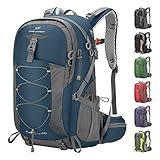


Our Top Picks
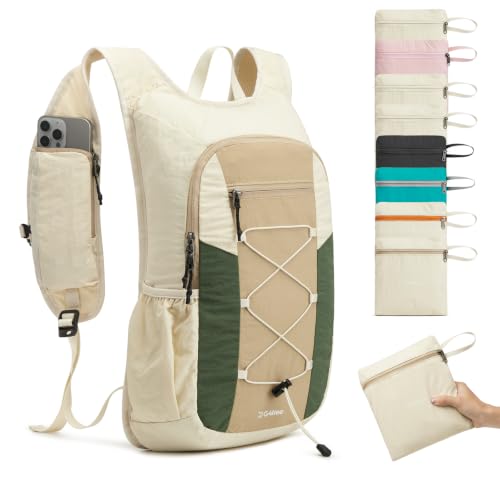 G4Free 20L Packable Hiking Backpack with Phone PocketSmall5.12 x 11.42 x 18.5 Inches0.64 poundsCheck on Amazon


Top 3 picks at a glance
How to Choose Capacity: Day Hike vs. Multi-Day
Capacity is measured in liters and directly dictates what system you need for weight distribution. Use this framework to narrow your search before looking at specific models.
| Trip Type | Ideal Capacity | Typical Base Weight | Frame Type Needed | Example Use Case |
|---|---|---|---|---|
| Day Hike (2-8 hours) | 18-30L | 5-10 lbs / 2-4.5 kg | Frameless or light perimeter frame | Water, layers, lunch, first aid, rain shell |
| Overnight / Fastpacking | 30-45L | 10-18 lbs / 4.5-8 kg | Internal frame with hip belt | Ultralight tent, quilt, stove, 1-2 days food |
| Multi-Day (3-5 days) | 50-65L | 18-30 lbs / 8-13.5 kg | Full internal frame, padded hip belt | Tent, sleeping bag, pad, 3 days food and fuel |
| Extended / Winter | 65-75L | 30-45 lbs / 13.5-20 kg | Heavy-duty internal frame, load lifters | Bear canister, winter layers, extra fuel |
A Worked Calculation: How Much Volume You Actually Need
Spec sheets list liters, but they don’t tell you if 55L is enough for your kit. Do a quick volume budget before you buy:
Formula: Total Volume Needed = (Big 3 Volume) + (Consumables Volume) + 15% buffer for packing inefficiency
Example for a 3-day summer trip:
- Shelter, sleep system, pad (The Big 3): ~32L (e.g., 14L tent + 10L sleeping bag in compression sack + 8L pad)
- Clothing and essentials: ~10L
- Food: ~1.5L per day x 3 days = 4.5L
- Water (2L bladder): 2L
- Subtotal: 48.5L. Add 15% buffer (7.3L) = 55.8L
In this scenario, a 55-60L pack like the Osprey Atmos AG 65 or Gregory Baltoro 65 gives you a usable main compartment without strapping gear outside. If your subtotal is under 35L, you don’t need more than a 40-45L pack, and carrying a larger one will hurt weight distribution.
Fit and Weight Distribution: The Real Comfort Factors
Comfort is not about padding thickness. It’s about where the weight sits on your skeleton.
1. Torso Length, Not Height
Hiking packs are sized by torso length (C7 vertebra to iliac crest), not your overall height. Most brands offer S/M/L sizing or an adjustable harness.
- Osprey Atmos AG 65: Available in S/M and M/L with adjustable harness, usually $270–$330
- Gregory Baltoro 65: Available in S/M/L with interchangeable hip belt, usually $300–$350
- Deuter Aircontact Lite 65+10: Available in multiple back lengths, usually $250–$300
If the hip belt sits on your hips and the shoulder straps wrap without gaps, the torso length is correct. If the hip belt rides on your waist, the pack is too long.
2. Hip Belt vs. Shoulder Load
A properly fitted multi-day pack should carry 70-80% of the weight on your iliac crest via the hip belt, leaving 20-30% on the shoulders for stability. Daypacks (under 25L) are designed for the opposite: 70-80% on the shoulders, since total weight is low.
Key features that affect this transfer:
- Load lifters: Straps from the top of the pack to the shoulder straps. At a 45-degree angle, they pull the pack’s center of gravity toward your back. They only work if the pack’s frame extends above your shoulders.
- Hip belt construction: Multi-day packs use dual-density foam and a stiff lumbar pad. Daypacks like the Osprey Talon 22 or Deuter Speed Lite 25 use a simple webbing belt – comfortable for 10 lbs but not for 25 lbs.
- Back panel ventilation: Suspended mesh (Osprey Anti-Gravity, Gregory FreeFloat) creates an air gap for cooling but moves the load 1-2 inches away from your back, which slightly reduces stability on scrambles. Foam-channel backs (Deuter Aircontact) sit closer and feel more stable but run hotter.
Weather Resistance: What “Waterproof” Really Means
No hiking backpack is fully waterproof from the factory unless it uses a roll-top with welded seams and waterproof fabric. Most use water-resistant fabrics and rely on design.
| Protection Level | How It Works | What It Handles | Limitation |
|---|---|---|---|
| DWR-Coated Nylon + Rain Cover | Durable Water Repellent causes beading; included rain cover for downpours | Light rain, snow, splash | DWR wears off, seams and zippers leak in sustained rain |
| 210D-420D Ripstop with PU Coating | Polyurethane coating on interior fabric | Moderate rain for 1-2 hours | Coating degrades after 3-5 years, not seam-taped throughout |
| Roll-Top + Waterproof Fabric (e.g., Dyneema, X-Pac) | Welded seams, waterproof zippers | Heavy rain, river crossings | Higher cost, usually $300–$500+, minimal organization |
For most hikers, the practical solution is a pack with a DWR coating plus an internal strategy: line the main compartment with a trash compactor bag or use dry sacks for your sleeping bag and clothes. This is lighter, cheaper, and more reliable than relying on an external rain cover, which can blow off and leaves your back panel exposed.
Decision Matrix: Which Pack Class Matches Your Hiking Style
Use your typical load and terrain to pick the right category, then compare models within that class.
| If You Usually… | Best Choice | Why | Models to Compare |
|---|---|---|---|
| Hike 3-8 miles with <12 lbs, want max ventilation | 18-26L Ventilated Daypack | Mesh suspension keeps back dry, frameless saves weight | Osprey Talon 22, Gregory Nano 24, Deuter Speed Lite 25 |
| Do long day hikes with extra layers and 3L water | 28-32L Daypack with Hip Belt | Better weight transfer for 12-18 lbs, often has hydration sleeve | Osprey Stratos 34, Gregory Zulu 30 |
| Backpack 2-3 nights, carry 25-35 lbs | 55-65L Lightweight Internal Frame | Full suspension with load lifters, still under 5 lbs pack weight | Osprey Atmos AG 65, Gregory Baltoro 65, Deuter Aircontact Lite 65+10 |
| Prioritize durability and heavy loads over weight savings | 65-75L Heavy-Duty Frame | Reinforced hip belt and frame can handle 40+ lbs comfortably | Gregory Baltoro 75, Osprey Aether Plus 70 |
| Fastpacking or ultralight overnight | 35-45L Roll-Top Ultralight | Minimal frame, waterproof fabric, sub-2 lb pack weight | Hyperlite Mountain Gear 3400 Southwest, Gossamer Gear Mariposa 60 |
What to Check Before You Buy
Spec sheets miss the details that determine long-term durability:
- Fabric denier: 100D-210D is light but can abrade on granite. 210D-420D ripstop nylon is the sweet spot for most multi-day packs. Check the bottom panel – it should be 500D+ or have reinforced Cordura.
- Zippers and buckles: YKK zippers and Woojin or Duraflex buckles are industry standards for reliability. Avoid packs with exposed coil zippers on the main compartment if you hike in dusty terrain.
- Hydration compatibility: Look for an internal sleeve and hose port if you use a reservoir. Some ultralight roll-tops omit this.
- Adjustability: An adjustable torso harness is worth the slight weight penalty if you are between sizes or will share the pack. Fixed-torso packs are lighter and simpler but require precise sizing.
Day Hike vs. Multi-Day: The Core Trade-Offs
Daypacks prioritize ventilation, access, and low weight. The best models weigh 1.5-2.5 lbs and offer panel loading (full front zip) so you can reach lunch or a layer without unpacking. They sacrifice load transfer and weather sealing.
Multi-day packs prioritize load stability and carry comfort. They weigh 4-6 lbs due to the frame, hip belt, and larger volume. They use top loading with a lid or roll-top, which is more weather-resistant and compresses better when partially full, but slower to access.
If you only buy one pack and you do both, a 30-35L pack with a supportive hip belt is the most versatile compromise. It can handle a light overnight with careful packing while still being comfortable for a long day hike. Going larger than 40L for day use will always feel cumbersome.
FAQ
What size backpack do I need for a day hike?
For most day hikes, 20-26L is sufficient. If you carry extra water, camera gear, or hike with kids and carry their layers, move up to 28-32L. Anything larger is unnecessary and will cause the pack to bounce.
How much should a hiking backpack weigh empty?
Daypacks should be 1.5-2.8 lbs, multi-day packs 3.8-5.5 lbs. Ultralight packs can be under 2 lbs but trade durability and suspension. A heavier empty weight is justified only if you consistently carry over 30 lbs.
Do I need a rain cover?
A rain cover helps, but it is not a complete solution. Water enters through the back panel and seams. For reliable protection, use a pack liner or dry sacks inside the pack, which protects your gear even if the outer fabric soaks through.