The best aquarium chillers are the ones sized for your actual water volume, room temperature, lighting load, and desired temperature drop—not simply the model with the highest horsepower.
Our Top Picks


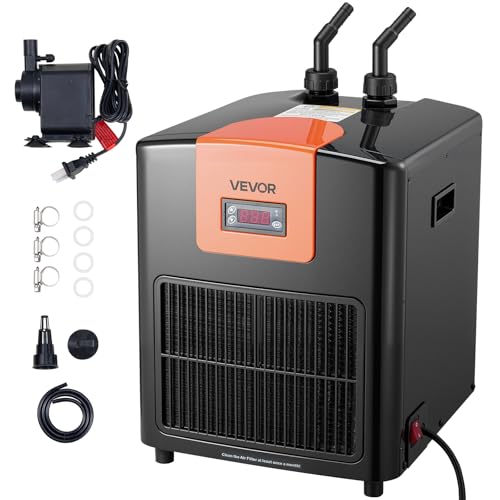
Top 3 picks at a glance
Quick picks by aquarium size
| Tank volume | Typical cooling class | Good fit | Expected power range |
|---|---|---|---|
| 20–40 gallons | 1/15–1/10 HP | JBJ Arctica Titanium 1/15 HP or a comparable nano chiller | Approximately 150–300 W while actively cooling |
| 40–75 gallons | 1/10–1/5 HP | JBJ Arctica Titanium 1/10 HP, TECO TK 150, or comparable class | Approximately 250–500 W |
| 75–125 gallons | 1/5–1/4 HP | JBJ Arctica Titanium 1/5 HP or TECO TK 500, depending on heat load | Approximately 400–800 W |
| 125–200 gallons | 1/4–1/3 HP | JBJ Arctica Titanium 1/4 HP or a larger TECO or Hailea unit | Approximately 600–1,100 W |
| 200+ gallons | 1/3 HP and above | Commercial-size TECO, Hailea, or Aqua Euro USA chiller | Often 900 W or more |
These are planning ranges rather than guarantees. Manufacturer capacity ratings can assume a particular ambient temperature, flow rate, and temperature reduction. A reef aquarium under powerful LED lighting may need the next larger size even when its water volume appears to fit a smaller unit.
As an Amazon Associate we earn from qualifying purchases at no extra cost to you.


How to match chiller size to your aquarium
Start with the true water volume, not the tank’s advertised capacity. Subtract the space occupied by rock, sand, equipment, and an external sump. A 90-gallon display with a 20-gallon sump may contain only about 85–95 gallons of water in operation.
Next, estimate the temperature difference the chiller must overcome. If your room reaches 80°F and you want the aquarium at 76°F, the unit must remove heat continuously while also lowering the water by 4°F. If the room reaches 86°F, the same aquarium has a much larger cooling requirement.
- Lightly stocked freshwater tank: Use the lower end of the capacity range if the room stays cool and lighting is modest.
- Planted tank with strong lighting: Add capacity because lights and their power supplies transfer heat into the water.
- Marine reef aquarium: Choose conservatively. Pumps, protein skimmers, return equipment, and lighting all add heat.
- Warm room or enclosed cabinet: Move up one chiller class unless the room itself is air-conditioned.
- Temperature-sensitive species: Favor stable, slower cycling over a barely adequate unit.
A useful sizing calculation
One US gallon of water weighs about 8.34 pounds, and cooling water by 1°F requires roughly 8.34 BTU per gallon. For a 75-gallon aquarium that must drop from 80°F to 76°F:
75 × 4 × 8.34 = approximately 2,502 BTU
That is the energy needed for the initial pull-down, not the ongoing heat entering the aquarium. Pumps and lighting may then add several hundred watts of heat every hour. Because real chillers lose capacity as the room gets hotter, a 1/5 HP class unit is usually a safer choice than selecting a small unit based only on the initial calculation.
Best aquarium chiller options by priority
Best all-around choice: JBJ Arctica Titanium series
The JBJ Arctica Titanium line is a practical match for many home aquariums because it is available in several small and medium cooling capacities, including approximately 1/15, 1/10, 1/5, 1/4, and 1/3 HP classes. Titanium heat exchangers suit both freshwater and saltwater applications, provided the installation follows the manufacturer’s requirements.
Choose the 1/15 HP class for a small aquarium with a moderate heat load, the 1/10 HP class for many 40–75 gallon setups, and the 1/5 HP class when a 75-gallon tank has strong lighting or a warm room. The main advantage is sizing flexibility: you can move up one model without jumping immediately to industrial equipment.
Best for compact installations: TECO TK series
TECO’s TK range is designed for aquarium cooling and includes compact models such as the TK 150 and larger units such as the TK 500, TK 1000, and TK 2000. The number in the model name refers to the approximate cooling class rather than a direct gallon rating, so compare the manufacturer’s capacity chart with your temperature target.
TECO units are appealing when cabinet space, appearance, and control features matter. They can be a good choice for aquarists who want a more polished installation, but confirm hose diameter, required flow, and ventilation clearance before buying. A compact chiller still releases heat into the room, and placing it inside a sealed cabinet can sharply reduce performance.
Best value-oriented larger-capacity option: Hailea HC series
Hailea HC-series chillers, including models such as the HC-130A, HC-150A, HC-250A, HC-300A, and HC-500A, are widely used in aquarium and hydroponic cooling applications. They often provide substantial cooling capacity for the money, particularly in medium and large systems.
The trade-off can be more noticeable fan and compressor noise than with premium compact designs. A Hailea unit makes sense when cooling capacity and budget matter more than living-room acoustics. Install it on a solid, level surface with generous ventilation and flexible tubing to reduce vibration transfer.
Best for a broad range of saltwater systems: Aqua Euro USA Max Chill
Aqua Euro USA Max Chill models cover multiple capacity classes and are commonly considered for reef systems and larger aquariums. Match the model using actual water volume and heat load rather than relying on a nominal horsepower label. These units can be useful when you need more capacity than a small nano chiller provides but do not want to move immediately to a commercial system.
Noise, energy use, and installation differences
| Chiller class | Typical sound expectation | Active electrical draw | Where it works best |
|---|---|---|---|
| 1/15–1/10 HP | Low to moderate fan and compressor hum | About 150–350 W | Bedrooms, offices, nano and medium aquariums |
| 1/5–1/4 HP | Moderate hum; vibration isolation helps | About 350–800 W | Medium reef and planted tanks |
| 1/3 HP and above | Clearly audible airflow and compressor operation | About 700–1,500 W or more | Large systems, fish rooms, and dedicated equipment areas |
Electrical consumption is not the same as the rating on the nameplate. A 500 W chiller that runs for 20 minutes each hour averages about 167 W over that hour:
500 W × one-third duty cycle = approximately 167 W average
At an electricity rate of around $0 per kilowatt-hour, that averages roughly $22 per month if it runs at that duty cycle continuously. Actual cost may be much higher in a hot room and much lower in a cool one. Oversizing moderately can reduce runtime, but an extremely oversized unit may cycle frequently instead of operating in longer, efficient periods.
Decision matrix: which type fits your setup?
| Your situation | Recommended approach | Why |
|---|---|---|
| 30-gallon tank, cool room, moderate LED lighting | 1/15 or 1/10 HP | Enough reserve without paying for a large compressor |
| 60-gallon reef, enclosed stand, warm summer room | Upper 1/10 or 1/5 HP class | Cabinet heat and pumps increase the load |
| 90-gallon reef, intense lighting, room reaches 82°F | 1/5 or 1/4 HP | A smaller unit may run nearly continuously |
| 150-gallon aquarium with a sump and multiple pumps | 1/4 or 1/3 HP | More water and equipment heat require reserve capacity |
| Chiller located beside a desk or bed | Quiet-focused compact model, plus vibration isolation | Sound matters as much as cooling capacity |
Installation details that affect real-world performance
Use the recommended pump flow rather than assuming higher flow is always better. Too little flow can cause poor heat transfer or trigger a flow alarm; excessive flow can reduce the water’s contact time with the heat exchanger and may exceed the unit’s rating.
- Place the chiller in open air, not in a sealed aquarium cabinet.
- Leave the manufacturer’s specified clearance around intake and exhaust vents.
- Use tubing and fittings that match the chiller’s ports and pump requirements.
- Keep the condenser free of dust; restricted airflow increases runtime and noise.
- Use a controller or built-in thermostat with a sensible differential, commonly around 1–2°F, to prevent rapid cycling.
- Put the temperature probe where it measures well-mixed tank water, away from the chiller outlet and hot equipment.
Frequently asked questions
Should I size a chiller using my aquarium’s advertised gallon capacity?
No—use the estimated amount of water actually in the operating system. Subtract the space taken up by rock, sand, equipment, and the sump from the display and sump capacity. The article’s example notes that a 90-gallon display with a 20-gallon sump may hold about 85–95 gallons of water in operation.
Does a chiller’s horsepower tell me how many gallons it can cool?
No—horsepower alone does not establish a reliable gallon rating. Capacity depends on conditions such as ambient temperature, flow rate, and the temperature reduction required. Compare the manufacturer’s capacity chart with your target temperature, and account for room heat, lighting, and equipment rather than choosing by the horsepower label alone.
Can I install an aquarium chiller inside a closed cabinet?
No—a sealed cabinet can sharply reduce a chiller’s performance. The unit releases heat into the room, so it needs open air and the manufacturer’s specified clearance around its intake and exhaust vents. Dust on the condenser can also restrict airflow, increasing runtime and noise.
How can I keep an aquarium chiller from turning on and off too often?
Use a thermostat differential that allows a sensible temperature range, commonly around 1–2°F. Place the probe in well-mixed tank water, away from the chiller outlet and hot equipment. The article also cautions that an extremely oversized unit may cycle frequently rather than run in longer, efficient periods.
Does a chiller need a particular pump flow rate?
Yes—use the flow rate recommended for the chiller rather than assuming more flow is better. Too little flow can impair heat transfer or trigger a flow alarm, while excessive flow may reduce contact time with the heat exchanger or exceed the unit’s rating. Check the unit’s pump requirements and port specifications.
Final buying recommendation
For most home aquariums, select a JBJ Arctica Titanium or comparable 1/10–1/5 HP chiller for a 40–75 gallon system, then move to 1/4 HP when the aquarium has strong lighting, a warm room, or a substantial equipment load. Choose TECO when compact design and quieter living-space installation are priorities, Hailea when capacity per dollar matters most, and a larger Aqua Euro USA or commercial-class unit for high-volume reef systems.
The safest purchase is usually one capacity step above the minimum rating, provided the unit has adequate ventilation and a thermostat that prevents short cycling. That reserve lets the chiller pull the aquarium back to its target temperature during the hottest part of the day instead of running continuously.