The best espresso machines for home baristas in 2026 are not one single model but four distinct classes: compact thermoblock single-boilers for tight counters and milk-light drinkers, traditional single-boiler machines like the Gaggia Classic Pro and Rancilio Silvia for learning fundamentals, heat-exchanger and dual-boiler machines like the Lelit Bianca and ECM Synchronika for back-to-back milk drinks, and integrated grinder machines like the Breville Barista Express Impress for all-in-one convenience.
As an Amazon Associate we earn from qualifying purchases at no extra cost to you.


Our Top Picks
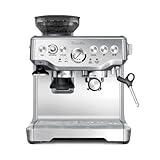
 Breville BES870XL Barista Express Espresso MachineLarge13.8 x 12.5 x 15.9 inches22.09 PoundsCheck on Amazon
 Breville BES870BTR Barista Express Espresso Machine213.81 x 12.53 x 15.9 inches22.09 poundsCheck on Amazon

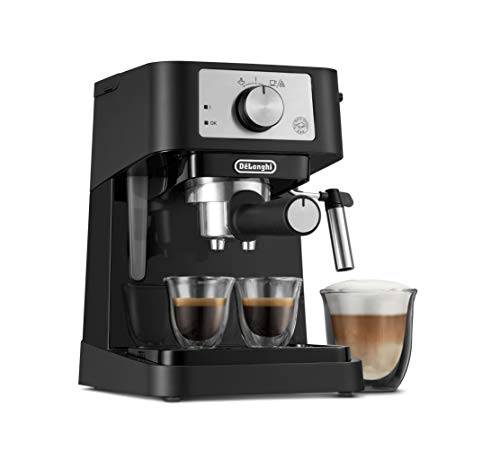
Top 3 picks at a glance
Quick Decision Matrix: Which Class Fits You?
Use your counter space, drink habits, and willingness to learn dialing-in as the filter. This matrix maps common home situations directly to the right architecture.
| Situation | Best Fit Class | Why | Typical Price Range |
|---|---|---|---|
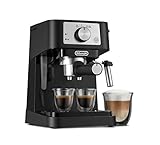
| Less than 14 inches wide, 1-2 milk drinks per day | Compact Thermoblock (e.g., Breville Bambino Plus, De’Longhi Dedica Arte) | 10-12″ footprint, 3-second warm-up, auto milk frothing | usually $300–$500 |
| You want to learn manual espresso and already own a good grinder | Traditional Single Boiler (e.g., Gaggia Classic Pro, Rancilio Silvia) | 58mm commercial-style group, full manual control, forces technique | usually $450–$850 |
| 3+ lattes/cappuccinos back-to-back or entertaining | Heat-Exchanger or Dual Boiler (e.g., Lelit Mara X, Lelit Bianca, ECM Synchronika) | Brew and steam simultaneously, no temperature surfing | usually $1,400–$2,800 |
| No grinder yet, want minimal separate gear | Integrated Grinder Machine (e.g., Breville Barista Express Impress) | Built-in conical burr grinder, assisted tamping, smaller learning curve | usually $600–$900 |
| Small kitchen but high volume | Compact Dual Boiler (e.g., Breville Dual Boiler BES920) | Dual boiler performance in ~14.5″ width, but needs depth | usually $1,500–$1,700 |
Compared Head-to-Head: The 5 Criteria That Matter at Home
1. Counter Footprint and Depth
Spec sheets list width but ignore the real footprint with portafilter, grinder, and steam clearance. A true home setup needs width + depth + vertical clearance to lift the water tank lid.
| Class | Machine Width | Depth With Portafilter | Height With Lid Open | Grinder Needed? |
|---|---|---|---|---|
| Compact Thermoblock | 7.7″ – 9.5″ | 14″ – 16″ | 16″ – 17″ | Separate, required |
| Traditional Single Boiler | 9.5″ – 11″ | 17″ – 19″ | 17″ – 18.5″ | Separate, required |
| Integrated Grinder | 13″ – 14″ | 17.5″ – 19″ | 17.5″ | Built-in |
| Heat-Exchanger (E61) | 11″ – 13″ | 21″ – 24″ | 18″ – 19″ | Separate, required |
| Dual Boiler (E61 / Saturated Group) | 11.5″ – 14.5″ | 22″ – 25″ | 18″ – 19.5″ | Separate, required |
If your counter is under 18 inches deep or has upper cabinets at 18 inches, compact thermoblock or integrated models are the only classes that fit without pulling the machine forward for every shot. E61 heat-exchanger and dual boiler machines need 24+ inches of depth to accommodate the protruding portafilter and rear water tank access.
2. Warm-Up Time and Workflow
Warm-up time determines whether you can make espresso on a weekday morning or only on weekends.
- Thermoblock (Bambino Plus, Dedica): 3 to 10 seconds to brew temperature. Ready almost instantly because only a small heated block is warmed, not a full boiler.
- Traditional Single Boiler (Gaggia Classic Pro, Silvia): 5 to 8 minutes for brew temp, 15+ minutes for full thermal stability of the brass group head. Requires temperature surfing or waiting for the group to saturate.
- Integrated Grinder (Barista Express Impress): Thermocoil system, about 30 to 45 seconds to stable temperature. PID-controlled but still needs a short flush if left on.
- Heat-Exchanger (Lelit Mara X, Rocket Appartamento): 20 to 30 minutes to fully heat the large boiler and E61 group. Fast HX flush needed before first shot.
- Dual Boiler (Bianca, Synchronika, Breville Dual Boiler): 15 to 25 minutes with PID saturated groups; E61 versions closer to 25-30 minutes. Brew boiler can be turned off independently to save time if you only want espresso.
For back-to-back drinks, the ranking flips. A single boiler needs 60-90 seconds to switch from brew (93°C) to steam (155°C) and then back, including purging. A thermoblock switches in 5-10 seconds but with weaker steam. Heat-exchanger and dual boilers brew and steam simultaneously with no waiting.
3. Milk-Steaming Ability
Steam power is measured by time to texture 6 oz of milk and recovery time.
- Thermoblock auto-frothing: 45-60 seconds for 6 oz, hands-free but produces thicker, less micro-foam. Good for lattes, struggles with dense flat-white microfoam. Recovery is instant.
- Single boiler panarello/manual wand: 30-45 seconds for 6 oz. The Gaggia Classic Pro and Silvia have single-hole tips that reward technique with excellent microfoam, but you get one shot of steam before the boiler pressure drops and needs 60 seconds to rebuild.
- Heat-exchanger: 20-30 seconds for 6 oz, continuous steam. Strong dry steam, can texture 12 oz for two drinks without pressure loss.
- Dual boiler: 15-25 seconds for 6 oz, dedicated steam boiler at 1.5-2 bar. Best for latte art; can steam and pull shots at the same time for 4-6 drinks in a row.
If you make more than two milk drinks in a row, a single boiler becomes a bottleneck. If you drink mostly straight espresso or Americanos, steam power should not drive your budget.
4. Grinder Needs and True Cost
Every class except integrated grinder machines requires a capable separate grinder. Espresso requires 200-400 micron grind adjustments of 10-20 microns at a time, which blade grinders and most drip-focused burr grinders cannot do.
Budget accordingly: a suitable espresso grinder (e.g., Baratza Sette 270, Eureka Mignon Specialita, DF64 Gen 2) typically adds $300–$600 to any separate-grinder class. An integrated machine like the Barista Express Impress bundles this, but its stepped grinder has wider steps and more retention than a dedicated Eureka or DF grinder, meaning less precision for light roasts.
Learning curve is tied directly to the grinder. Machines with pressurized baskets (included with Dedica and Bambino) can use pre-ground coffee and are forgiving, but they do not produce true espresso. Switching to the included non-pressurized baskets requires a proper grinder and dialing in.
5. Learning Curve
- Lowest: Compact thermoblock with pressurized basket + auto steam. Dose, tamp lightly, press button.
- Low-Medium: Barista Express Impress. Assisted tamping and dose correction reduce channeling, but you still learn grind size and yield.
- Medium: Gaggia Classic Pro / Silvia. Fully manual shot timing, temperature surfing, and manual steaming. The most educational for under $900.
- High: Heat-exchanger and dual boiler E61. You must manage grind, dose, distribution, HX flush timing, and steam pressure, but PID and pressure gauges give full control for light roasts.
Power Budget Calculation: Can Your Kitchen Circuit Handle It?
Most home espresso machines run on a standard US 120V 15A kitchen circuit (1,800W max, 1,440W continuous at 80% rule). This is information spec sheets omit.
Worked example for a typical morning setup on one outlet strip:
- Dual boiler machine heating both boilers: 1,400–1,700W peak during initial heat-up
- Grinder (Eureka Mignon): 260W peak for 8 seconds
- Electric kettle for Americano: 1,200W
Combined peak if the machine is heating and you grind and boil at the same time: 1,700 + 260 + 1,200 = 3,160W, which will trip a 15A breaker instantly.
Practical rule: Never share the espresso machine’s outlet with a kettle, toaster, or microwave. A compact thermoblock at 1,300–1,450W peak can share a 20A (2,400W) kitchen circuit with a grinder, but not with another heating appliance. If your kitchen has only one 15A circuit, choose a thermoblock or single boiler (1,300–1,425W) and run the kettle sequentially, or run the espresso machine in eco/ brew-boiler-only mode which typically caps draw at 1,000–1,100W.
Energy cost is minor: A dual boiler left on 2 hours per day at ~0.3 kWh per hour idle (steam boiler on) uses about 0.6 kWh/day, or roughly $0–around $0 per day at US average around $0/kWh. Using a smart plug timer to heat 30 minutes before use instead of leaving it on all day saves 70% of that standby cost.
Concrete Starting Settings to Dial In Faster
These are baseline values for a 58mm non-pressurized double basket, not rules. Adjust grind to hit the target time, not to match a visual grind setting.
- Dose: 18g in / 36g out (1:2 ratio) for medium roasts. For light roasts, try 18g in / 45g out (1:2.5) to reduce sourness. For dark roasts, 18g in / 32g out (1:1.78) to reduce bitterness.
- Brew time: 27–32 seconds from pump on, including 5–8 seconds preinfusion if your machine has it (Bianca, Silvia Pro X, Breville Dual Boiler). If the shot runs 20 seconds, grind finer by one small notch. If it chokes past 35 seconds, grind coarser.
- Temperature: 93°C (199°F) for medium roasts as a starting point. Light roasts: 94–96°C. Dark roasts: 90–92°C. Single boilers without PID run roughly 2–3°C hotter right after the ready light turns on; flush 2–3 seconds before brewing to drop to target.
- Milk texturing: Purge wand 2 seconds before and after. For 6 oz milk, introduce air with the tip just kissing the surface for 3–5 seconds until the pitcher is lukewarm, then submerge to create a vortex until 60–65°C (140–149°F). Thermoblock auto wands skip this but need cold milk and a cold pitcher.
If your shot channels (uneven, spritzing, pale blonding early), the fix order is: 1) grind finer and distribute more evenly, 2) use a WDT tool to break clumps, 3) tamp level without extra force, 4) reduce dose by 0.5g if the puck touches the shower screen.
How to Choose in 2026
For most home baristas with limited space who drink milk drinks occasionally, a compact thermoblock like the Bambino Plus plus a dedicated grinder in the $350–$450 range gives the fastest workflow and smallest footprint. If your goal is to master espresso technique and you have space for a separate grinder, a traditional single boiler like the Gaggia Classic Pro or Rancilio Silvia remains the best value learning platform. Choose heat-exchanger or dual boiler only if you regularly make 3 or more milk drinks consecutively or want PID and flow control for light roasts; otherwise the extra cost, warm-up time, and counter depth do not pay off.
Frequently asked questions
Can I make espresso without buying a separate grinder?
Yes, an integrated grinder machine can eliminate the need for a separate grinder. Compact machines with pressurized baskets can also use pre-ground coffee, but switching to non-pressurized baskets requires a proper grinder and dialing in. A built-in stepped grinder is more convenient, though it offers less precision and more retention than a dedicated grinder.
What is the difference between pressurized and non-pressurized baskets?
Pressurized baskets are more forgiving and can work with pre-ground coffee, while non-pressurized baskets require a proper espresso grinder and dialing in. Pressurized baskets simplify the process, but the article says they do not produce true espresso. Non-pressurized baskets provide the approach used for the stated baseline dose and yield settings.
Can I prepare espresso and steam milk at the same time?
Yes, heat-exchanger and dual-boiler machines can brew and steam simultaneously. Traditional single-boiler machines cannot; they require time to switch from brew to steam and then back again, including purging. Thermoblock machines switch quickly but have weaker steam. For more than two milk drinks in a row, a single boiler becomes a bottleneck.
How much counter clearance should I leave above an espresso machine?
Leave enough vertical clearance to lift the water-tank lid, not merely enough space for the machine body. The article notes that spec sheets can overlook portafilter, grinder, steam, and tank-access space. If upper cabinets are at eighteen inches, compact thermoblock or integrated models are the only classes identified as fitting without pulling the machine forward for every shot.
Can a smart plug reduce the electricity used by an espresso machine?
Yes, using a smart plug timer to heat the machine before use instead of leaving it on all day can save seventy percent of standby cost, according to the article. A dual boiler left on for two hours per day uses about zero point six kilowatt-hours daily when its steam boiler remains on. The machine should still avoid sharing an outlet with another heating appliance.