The best electric griddles for most households are a 22-inch family model with an adjustable thermostat and removable drip tray; smaller 8–10-inch griddles suit one or two people, while premium units earn their price through tighter temperature control and easier cleanup.
As an Amazon Associate we earn from qualifying purchases at no extra cost to you.

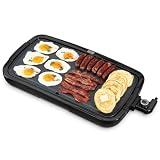


Our Top Picks
 Chefman XL Electric Griddle with Removable Temperature Control10" x 20"11.7 x 21.4 x 3.2 inches4.4 PoundsCheck on Amazon
 Presto 07047 16-Inch Cool Touch Electric Griddle16-Inch18.5 x 2.25 x 11.25 inches4.6 PoundsCheck on Amazon


Top 3 picks at a glance
Quick comparison: which griddle fits your household?
| Household and use | Useful cooking area | Best feature priority | Suitable choice | Typical market range |
|---|---|---|---|---|
| One person, occasional breakfast | 80–100 sq. in. | Compact storage and low minimum heat | Dash-style compact griddle | Usually $25–$45 |
| Two people | 100–160 sq. in. | Easy cleaning and accurate adjustment | 10–12-inch premium griddle | Usually $90–$180 |
| Three or four people | 180–250 sq. in. | Surface area and grease management | Presto 07061 or similar 22-inch model | Usually $45–$80 |
| Large family or batch cooking | 240+ sq. in. | Recovery after adding cold food | Presto 07046 Tilt’n Drain Big Griddle or similar | Usually $55–$100 |
Best overall for family breakfasts: Presto 07061 22-inch Electric Griddle
A large Presto-style griddle is the strongest all-purpose choice when several people need breakfast at the same time. The 07061 provides a broad cooking surface, an adjustable heat control, and a removable drip tray. Its advantage is not a premium control system; it is the ability to cook multiple foods without constantly clearing space.
A surface around 22 by 11 inches provides approximately 242 square inches before allowing for edge space. Four-inch pancakes need room to spread and flip, so a practical load is usually six to eight pancakes rather than the theoretical maximum. That can cover a family breakfast in one or two batches. By comparison, an 8 by 10-inch compact griddle has only 80 square inches, or roughly one-third as much usable space.
The main compromise is storage. A 22-inch appliance needs a shelf, drawer, or vertical slot wide enough for its body, and its temperature-control probe is usually removable but still needs a safe place. Choose this size if simultaneous cooking matters more than putting the appliance away in a kitchen cabinet.
Best for grease control: Presto 07046 Tilt’n Drain Big Griddle
The 07046 is a useful choice for bacon, sausage, burgers, and other foods that release substantial fat. Its tilt-and-drain design directs grease toward the collection area instead of leaving it distributed across the cooking surface. That can make cleanup quicker and reduces the amount of fat left around food during cooking.
Tilting is not ideal for every recipe. Pancake batter can move toward the lower edge, and eggs may cook unevenly if the surface is noticeably angled. Keep the griddle level for pancakes, French toast, and eggs; use the drain position after cooking fatty foods or when the recipe benefits from removing rendered grease.
For households that cook mostly pancakes and grilled cheese, a conventional flat family griddle may offer a more predictable surface. For households that cook a full breakfast with bacon or sausage every weekend, the drainage feature is more valuable than a small difference in maximum temperature.
Best for precise low-temperature cooking: Zojirushi Gourmet Sizzler EA-DCC10
The Zojirushi EA-DCC10 Gourmet Sizzler is a premium, roughly 10.5-inch-class electric griddle aimed at cooks who value controlled heating over maximum capacity. Its temperature range and control design make it better suited to delicate foods such as pancakes, eggs, and French toast than inexpensive models whose thermostats cycle more noticeably.
Its smaller surface changes the way it should be used. It is well suited to one or two servings, but it is not a practical replacement for a 22-inch family griddle when everyone needs food at once. A smaller area also means less room to separate foods with different cooking temperatures.
Premium construction can improve consistency, but it does not eliminate normal temperature cycling. The cooking surface will still cool when cold batter or meat is added. Preheat fully, add food in a single layer, and wait for the indicator or thermostat cycle to settle before judging the temperature.
Best compact choice for one or two people
A compact Dash-style electric griddle is a sensible choice for a student, apartment dweller, or cook who usually prepares one or two portions. These models take less counter space, heat a small area relatively quickly, and are easier to store in a normal cabinet than a full-size appliance.
The limitation is capacity rather than cooking ability. An area of about 80–100 square inches may handle two pancakes, two eggs, or a grilled sandwich batch, but crowding becomes a problem quickly. Overcrowding traps steam, slows browning, and makes it difficult to turn food without disturbing neighboring pieces.
Compact griddles are also more sensitive to the position of the food. Cooking near the thermostat or heating zone can produce a different result from cooking at the opposite edge. Rotate food when necessary instead of assuming the entire surface has identical heat.
How much surface area do you really need?
Use the following practical calculation rather than relying only on the advertised dimensions:
- A 22 × 11-inch surface has 242 square inches of gross area.
- Reserve roughly 15 percent for edges, handles, and comfortable turning space: 242 × 0.85 = about 206 usable square inches.
- A 4-inch pancake occupies about 12.6 square inches, but needs additional clearance for a spatula and spreading batter.
- Six pancakes therefore require approximately 6 × 20 = 120 practical square inches, leaving useful room for turning or cooking eggs.
This is why a 22-inch model can serve a family even though the raw pancake calculation appears to allow more. Food geometry, spatula access, and separation are more important than filling every available inch. For four people, choose a large griddle if you want to serve the meal together; choose a compact model only if staggered batches are acceptable.
Temperature control and consistency
Look for an adjustable thermostat rather than a single on/off switch. A useful cooking range is approximately 200–400°F, although the exact scale differs by model. Lower settings help with eggs and warming; medium settings suit pancakes and French toast; higher settings are useful for browning burgers, hash browns, and grilled sandwiches.
| Food | Starting temperature | What to watch for |
|---|---|---|
| Eggs | 250–300°F | Reduce heat if the whites brown before setting |
| Pancakes | 325–350°F | Wait for bubbles and dry edges before turning |
| French toast | 325–350°F | Use moderate heat so the center cooks before the crust burns |
| Hash browns | 350–375°F | Do not overcrowd; moisture prevents crisping |
| Burgers and sausage | 350–400°F | Drain excess grease and verify food reaches a safe internal temperature |
Temperature consistency depends on the thermostat, heating element placement, surface thickness, and how much cold food is added at once. A heavy surface usually recovers more steadily, while a light surface may heat quickly but lose more heat when loaded. For repeatable pancakes, preheat for at least five minutes, cook a test pancake, and adjust in small increments rather than changing the dial dramatically.
Grease handling and cleaning
A removable drip tray is more important than a slightly higher maximum temperature for bacon-heavy cooking. Check whether the tray is large enough for a full batch and whether it can be removed without lifting or tilting a hot appliance. Tilt-and-drain designs are especially helpful when cooking fatty meat, but they should not be used at an angle for liquid batters.
Let the griddle cool until it is warm rather than hot, then remove loose food with a soft spatula. Wipe grease into the tray, wash removable parts according to the manufacturer’s instructions, and keep the electrical temperature probe dry. Avoid immersing a connected control assembly, even if the cooking plate itself is advertised as washable.
Storage: the overlooked buying decision
Measure the storage location before buying. A large griddle may fit the shelf by width but fail because of its attached handles, control probe, or drip tray. Models with removable controls and compact trays are easier to store vertically. A 10-inch model can often live in a cupboard, while a 22-inch model may need a pantry shelf or dedicated drawer.
Do not store heavy cookware on a nonstick surface. If cabinet space is limited, choose the smaller model you can leave accessible; an appliance that is difficult to retrieve is less useful than a slightly less capable one that is ready for breakfast.
Final buying decision
- Choose a 22-inch family griddle for three or more people, batch pancakes, and one-pan breakfasts.
- Choose a tilt-and-drain model if bacon, sausage, burgers, and grease-heavy meals are regular menu items.
- Choose a premium 10–12-inch griddle when low-temperature control and compact capacity matter more than serving everyone simultaneously.
- Choose a compact Dash-style model for one or two portions, limited counter space, and easy storage.
- Prioritize an adjustable thermostat, removable drip tray, usable surface dimensions, and storage measurements before chasing maximum wattage.
Frequently asked questions
Can I use a tilt-and-drain griddle for pancakes and eggs?
You can, but keep the griddle level while cooking pancakes, French toast, and eggs. Tilting may cause pancake batter to move toward the lower edge and can make eggs cook unevenly. The drain position is more useful after cooking bacon, sausage, burgers, or other fatty foods, especially when removing rendered grease improves cleanup.
How should I preheat an electric griddle for pancakes?
Preheat the griddle for at least five minutes, then cook a test pancake before preparing the full batch. Pancakes generally suit a temperature around 325–350°F. Wait for bubbles and dry edges before turning, and adjust the thermostat in small increments rather than changing the dial dramatically.
What should I do if my griddle surface heats unevenly?
Rotate food when necessary instead of assuming the entire cooking surface has identical heat. Compact griddles can produce different results near the thermostat or heating zone than at the opposite edge. Temperature consistency also depends on thermostat cycling, heating-element placement, surface thickness, and how much cold food is added at once.
How do I clean an electric griddle safely?
Let the griddle cool until it is warm rather than hot, then remove loose food with a soft spatula and wipe grease into the tray. Wash removable parts according to the manufacturer’s instructions. Keep the electrical temperature probe dry, and never immerse a connected control assembly, even when the cooking plate is washable.
Can a compact griddle prepare food for several people?
A compact griddle can prepare food for several people only through staggered batches. Its smaller surface is suited to one or two portions, while crowding can trap steam, slow browning, and make turning food difficult. Choose a large griddle when you want to serve a meal together, particularly for a family breakfast.