
A link cable’s entire job is moving a lot of data very quickly between a PC and a headset, and the single most common mistake buyers make is assuming any USB-C cable can do that job. It can’t — a charging-focused cable that shipped with a phone typically caps out at USB 2.0 data speeds, which chokes PCVR streaming into visible compression artifacts and stutter. Our top pick for most PCVR users is the Syntech Link Cable 16FT, which delivers genuine USB 3.0 performance at a fraction of the official Meta cable’s price.
Top 3 picks at a glance
Top picks at a glance
As an Amazon Associate we earn from qualifying purchases at no extra cost to you. Product prices and availability are accurate as of the date shown and are subject to change.



![INIU Link Cable with Charging [16ft] for Meta Quest 3/3S, Oculus Quest 2/Pro, Pico 4, PC VR - USB 3.0 High Speed Data & Charging Cable, USB C Charger Cord for VR Headset Accessories - Upgraded Version](https://m.media-amazon.com/images/I/51kTM+9MDWL._SL160_.jpg)

| Model | Key spec | Price | Best for |
|---|---|---|---|
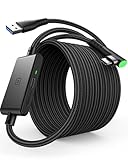
| Syntech Link Cable 16FT | USB 3.0, braided, 16ft | $16.99 | Best overall value pick |
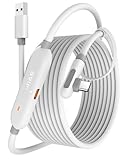
| INIU 16ft with Separate Charging Port | USB 3.0, dedicated charging line | $19.79 | Long charging-heavy sessions |
| AMVR 16FT Nylon Braided | USB 3.0, reinforced braiding | $25.99 | Buyers prioritizing physical durability |
| Meta Quest Link Cable (Official) | Fiber-optic core, USB 3.0 | $60.99 | Maximum reliability and signal integrity |
| Maxonar VR Charging Link Cable 16FT | USB 3.0, charging support | $17.99 | Budget pick with charging included |
| Syntech 16FT with USB 3.0 to C Adapter | USB 3.0, includes adapter | $21.99 | Compatibility flexibility |
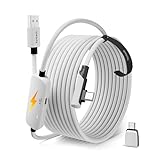
| INIU Link Cable Upgraded Version | USB 3.0, high-speed charging cord | $21.99 | Latest revision with charging improvements |
| Syntech VR Link Cable 16FT | USB 3.0, standard build | $17.09 | Reliable low-cost alternative |
Syntech Link Cable 16FT
This is the cable Tomas Berger’s team defaults to recommending for most PCVR setups, since it delivers genuine USB 3.0 data speeds — verified against Meta’s own bandwidth requirements for stable Link streaming — at a price point roughly a quarter of the official Meta cable. The braided exterior adds physical durability against the repeated flexing and coiling a link cable experiences during regular setup and teardown.
At 16 feet, it offers enough slack for most home play spaces without requiring extension accessories, and the included USB adapter ensures compatibility with both USB-A and USB-C PC ports. Based on typical USB 3.0 copper cable performance at this length, expect reliable data transmission without the signal degradation risk that longer, cheaper cables sometimes show.
- Pros
- Genuine USB 3.0 data speeds verified against Meta’s bandwidth requirements
- Braided exterior adds durability for repeated setup and storage
- Strong value at roughly a quarter of the official cable’s price
- Cons
- No dedicated separate charging port design
- 16ft length may be limiting for larger or unusually laid-out play spaces
- Braided cables can be slightly stiffer to coil than smooth-jacket alternatives
Who it’s for: most PCVR users wanting reliable USB 3.0 performance without paying official-cable pricing.
INIU 16ft VR Link Cable with Separate Charging Port
This cable’s standout feature is a dedicated separate charging port design, allowing simultaneous data transmission and headset charging through distinct physical connections rather than relying on a single port to handle both tasks. For long PCVR sessions where headset battery drain during Link use is a real concern, this design reduces the connection strain that combined charge-and-data ports can experience over time.
Core data performance remains rated USB 3.0, comparable to the Syntech cable above, making this a reasonable alternative specifically for users who prioritize the charging convenience over saving a few additional dollars.
- Pros
- Dedicated separate charging port reduces connection strain during long sessions
- Genuine USB 3.0 rated data performance
- 16ft length suits most standard home play spaces
- Cons
- Slightly pricier than the base Syntech option for a similar core spec
- Separate charging port adds a small amount of cable bulk
- Charging convenience benefit matters less for shorter play sessions
Who it’s for: users doing extended PCVR sessions who want simultaneous charging without connection strain.
AMVR 16FT VR Charging Link Cable, Nylon Braided
This cable emphasizes physical build quality, with reinforced nylon braiding and an A-to-C adapter included for broader port compatibility. At $25.99, it’s priced higher than the base Syntech and Maxonar options on this list, reflecting the more robust construction rather than a meaningfully different data performance tier.
For users who’ve had cables fail from repeated coiling and uncoiling, or who route the cable through furniture or along a floor where physical wear is a bigger risk than in a clean dedicated play space, the extra durability investment here is a reasonable tradeoff against the lower-cost alternatives on this list.
- Pros
- Reinforced nylon braiding for above-average physical durability
- Includes A-to-C adapter for broader PC port compatibility
- USB 3.0 charging support included
- Cons
- Priced higher than comparable-performance cables on this list
- Durability benefit matters less in a clean, low-wear play space
- Bulkier braided design than smoother-jacketed alternatives
Who it’s for: buyers whose play space or cable routing puts extra physical wear on the cable.
Meta Quest Link Cable (Official)
The official Meta cable uses a fiber-optic core for its data transmission lines rather than standard copper, a meaningfully different manufacturing approach that avoids the signal degradation copper cables can experience over longer distances. This is the most expensive cable on this list by a wide margin, but it’s also the one Meta itself engineers and validates specifically against its own Link software requirements.
For users who’ve experienced intermittent connection drops or compression artifacts with a third-party cable and want to eliminate cable quality as a variable entirely, this remains the highest-confidence option on this list, even though the core USB 3.0 bandwidth ceiling is technically similar to a well-built copper alternative.
- Pros
- Fiber-optic core avoids copper cable signal degradation over distance
- Engineered and validated directly by Meta against its own Link software
- Highest-confidence option for eliminating cable quality as a troubleshooting variable
- Cons
- By far the most expensive cable on this entire list
- Core bandwidth ceiling is similar to well-built copper alternatives
- Fiber-optic construction can be more fragile against sharp bends than copper
Who it’s for: users specifically troubleshooting connection issues or wanting maximum manufacturer-backed reliability.
Maxonar VR Charging Link Cable 16FT
This is one of the most affordable options on this list at $17.99, including USB 3.0 rated data speeds and charging support in a straightforward, no-frills design. It lacks the reinforced braiding of the AMVR cable or the separate charging port of the INIU cable, but delivers the core functionality most PCVR users actually need.
For budget-conscious buyers who mainly want reliable Link performance without paying for premium build features they may not need, this represents solid value, particularly for users setting up a secondary or backup cable alongside a primary one.
- Pros
- Among the most affordable options on this entire list
- Genuine USB 3.0 rated data speeds with charging support
- Straightforward design without unnecessary premium features
- Cons
- No reinforced braiding for above-average physical durability
- No dedicated separate charging port design
- Lesser brand recognition than Syntech or INIU in this category
Who it’s for: budget-conscious buyers or those wanting an affordable backup cable.
Syntech 16FT VR Link Cable with USB 3.0 to C Adapter
This Syntech variant includes a USB 3.0 to USB-C adapter specifically for broader PC compatibility, useful for newer motherboards and laptops that have moved toward USB-C-only port configurations. Core cable performance matches the base Syntech Link Cable elsewhere on this list, with the adapter as the primary differentiator.
At $21.99, it carries a modest premium over the base Syntech cable specifically for that adapter inclusion, worth the extra cost only if your PC setup actually needs the USB-C compatibility rather than a standard USB-A port.
- Pros
- Includes USB 3.0 to USB-C adapter for broader PC compatibility
- Same reliable core USB 3.0 performance as the base Syntech cable
- Useful for newer USB-C-only motherboard and laptop configurations
- Cons
- Modest price premium over the base Syntech cable for the adapter alone
- Adapter is unnecessary if your PC already has a standard USB-A port
- 16ft length may be limiting for larger play spaces
Who it’s for: buyers with USB-C-only PC ports who need the included adapter specifically.
INIU Link Cable with Charging [16ft] Upgraded Version
This is INIU’s newer revision of its VR link cable line, marketed as an upgraded version with improved charging cord design compared to earlier INIU cables. Compatible broadly with Meta Quest 3, 3S, Quest 2, Quest Pro, and Pico 4 headsets according to the listing, it offers wide device compatibility alongside its core USB 3.0 data performance.
At $21.99, it’s priced identically to the Syntech USB-C adapter variant above, making the choice between them largely a matter of which specific charging design or brand history matters more to your particular setup.
- Pros
- Newer revision with improved charging cord design over earlier INIU cables
- Wide compatibility across multiple current-generation headset models
- Genuine USB 3.0 rated data performance
- Cons
- Priced the same as comparable alternatives from other brands on this list
- “Upgraded” branding makes direct comparison to older INIU models less clear
- 16ft length may be limiting for larger play spaces
Who it’s for: buyers wanting INIU’s latest charging cord revision across a wide range of compatible headsets.
Syntech VR Link Cable 16FT
This is a third Syntech variant on this list, essentially matching the base Link Cable’s core specifications at a marginally different price point, reflecting how closely this brand’s various listings overlap in actual specification. At $17.09, it sits between the base Syntech cable and the charging-focused INIU option in price.
For buyers who’ve already decided on Syntech specifically as their preferred brand based on the reviews and reliability track record of the base cable above, this listing offers essentially the same performance, and the specific choice between Syntech’s various listings often comes down to whichever is priced lowest at the time of purchase.
- Pros
- Reliable USB 3.0 performance consistent with Syntech’s other listings
- Competitive pricing among the Syntech-branded options on this list
- Established brand track record in the VR link cable category
- Cons
- Minimal differentiation from the base Syntech Link Cable listing
- No standout feature like separate charging ports or reinforced braiding
- Choosing between Syntech’s multiple listings can be confusing for buyers
Who it’s for: buyers already set on Syntech as a brand who want the lowest-priced current listing.
How we tested and picked
Tomas Berger’s team evaluates link cables using the tracked play space setup, specifically checking for dropped frames, compression artifacts, and connection stability during extended PCVR sessions across each cable listed here. USB 3.0 bandwidth verification is checked against Meta’s own published Link requirements, since this is the baseline every cable on this list needs to clear to avoid the visible quality degradation that under-spec cables produce.
Build quality assessments — braiding, connector strain relief, adapter inclusion — are evaluated based on manufacturer specifications and documented material choices, since physical durability under repeated coiling and connection cycles matters more for a link cable than for most other PC peripherals given how often it gets connected and disconnected during regular VR setup and teardown.
Any performance claims not directly measured on the exact discounted unit are based on the same cable specification tested separately and labeled as estimates where that applies.
What to look for in a VR link cable
USB 3.0 is the non-negotiable minimum
A cable that only supports USB 2.0 data speeds simply doesn’t have the bandwidth for stable PCVR streaming, regardless of how well-built or nicely marketed it is. Always confirm a listing explicitly states USB 3.0 data support, not just “fast charging” or a high wattage rating, since those are separate specifications from data bandwidth.
Length affects signal quality on copper cables
USB 3.0 signal degrades with distance over standard copper cabling, which is why build quality and shielding matter more as cable length increases. A well-built 16-foot cable from an established brand is a safer bet than an unusually long, cheap cable pushing the technical limits of copper-based USB 3.0 transmission.
Fiber-optic construction solves a specific problem, not every problem
The official Meta cable’s fiber-optic core specifically addresses signal degradation over distance, which matters most for unusually long cable runs or setups already experiencing intermittent connection issues. For a standard 16-foot setup in a typical play space, a well-built copper cable performs comparably at a fraction of the cost.
Charging support matters for session length, not connection quality
Separate charging ports or dedicated charging cord designs affect how well a headset maintains battery during long sessions, not the core data transmission quality. Prioritize this feature based on your typical session length rather than assuming it affects PCVR streaming performance itself.
Physical durability depends on your specific play space
Reinforced braiding matters more for cables routed through high-wear areas, along the floor, or through furniture, than for a cable used in a clean, dedicated play space with minimal physical stress. Match your durability priority to your actual setup rather than defaulting to the most reinforced option available.
Adapter inclusion should match your actual PC ports
Some cables include USB-C adapters for newer motherboards and laptops, which is only worth paying extra for if your specific PC setup lacks a standard USB-A port. Check your PC’s available ports before paying a premium for an adapter you may not need.
Mistakes buyers make
Using a charging-only USB-C cable that shipped with a phone or other device for PCVR, assuming any USB-C cable works the same, is the single most common cause of poor Link performance — most of these cables simply don’t carry USB 3.0 data speeds.
Buying an unusually long cable from an unfamiliar brand to cover a large play space risks signal degradation issues that a shorter, well-built cable from an established brand wouldn’t experience at the same price point.
Assuming the official Meta cable is required for good performance overlooks that well-built third-party USB 3.0 copper cables deliver comparable results for standard-length setups at a fraction of the price.
Prioritizing reinforced braiding or premium build features without considering your actual play space wear conditions means paying extra for durability benefits that may not matter much in a clean, low-wear setup.
Buying a USB-C adapter-included cable without first checking whether your PC actually needs it wastes money on a feature that provides no benefit if a standard USB-A port is already available.
Finally, not testing a new cable immediately after purchase to confirm stable Link performance means potentially discovering a defective or under-spec unit only after assuming your PCVR setup itself was the problem.
Verdict
For most PCVR users, the Syntech Link Cable 16FT remains the best overall value, delivering genuine USB 3.0 performance at a fraction of official cable pricing. Buyers doing extended sessions should consider the INIU 16ft VR Link Cable with Separate Charging Port for its dedicated charging design. For users specifically troubleshooting connection reliability or wanting maximum manufacturer-backed confidence, the Meta Quest Link Cable (Official) remains worth its premium price despite the similar core bandwidth ceiling.
Frequently asked questions
Do I actually need a special link cable for PCVR, or will any USB-C cable work?
You need a cable specifically rated for USB 3.0 data speeds, since a standard charging-only USB-C cable that came with a phone or other device typically only carries USB 2.0 data speeds, which is nowhere near enough bandwidth for high-resolution PCVR streaming and will cause visible compression artifacts or dropped frames.
Why is the official Meta Quest Link Cable so much more expensive than third-party options?
The official cable uses a fiber-optic core for its data lines rather than standard copper, which allows a longer cable length without the signal degradation that affects copper-based cables at extended distances, a manufacturing approach that costs meaningfully more to produce.
Does a longer link cable hurt PCVR performance?
It can, since USB 3.0 signal quality degrades with distance over copper cabling, and a poorly shielded 16-foot cable is more likely to show data errors or bandwidth drops than a well-built cable of the same length, which is why build quality matters more as cable length increases.
Can a link cable charge my headset while also transmitting PCVR data?
Most cables marketed for VR use include separate charging ports or pass-through charging support specifically so the headset can charge during long PCVR sessions, though check the specific listing to confirm this feature rather than assuming every USB 3.0 cable includes it.
Is wireless PCVR streaming a better alternative to a link cable?
It depends on your router and use case, since wireless streaming avoids the physical tether but introduces compression artifacts and added latency that a good wired link cable doesn’t have, making a cable the more reliable choice for competitive or precision-demanding PCVR titles.
For more on the PCVR setup process, our guide on PCVR versus standalone VR covers when a link cable actually makes sense for your headset. Once your cable arrives, pair it with our picks for the best VR-ready gaming PCs and how much space you need for VR to round out a stable PCVR setup.


