Most people shop for a wall-mounted console the same way they shop for a regular TV stand: they check the width, the finish, and whether it fits a 65-inch TV. The weight rating is an afterthought, if they check it at all. That is the mistake that leads to sagging shelves, cracked drywall, and consoles that pull away from the wall a few months after installation.
A console wall mount weight rating is not like a simple weight limit on a bookshelf. It is a system rating that depends on what the console is made of, how it is built, how it attaches to the wall, and where in the wall it is attached. A manufacturer can list “supports up to 150 lbs” and still have that rating fail in your home if it is only valid when mounted into three studs with the included lag bolts and you mount it into drywall anchors alone. Understanding what that number actually means in 2026, when TVs are larger but media components are lighter and more scattered than ever, is the difference between a floating console that feels solid for a decade and one you never fully trust.
As an Amazon Associate we earn from qualifying purchases at no extra cost to you.


Our Top Picks
 Modway Render 46" Mid-Century Modern Wall Mount Media46 Inch46 x 15.5 x 14.5 inches46 poundsCheck on Amazon
 Modway Render 60" Mid-Century Modern Wall Mount Media60 inches60 x 15.5 x 14.5 inches56 poundsCheck on Amazon
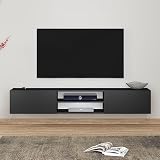
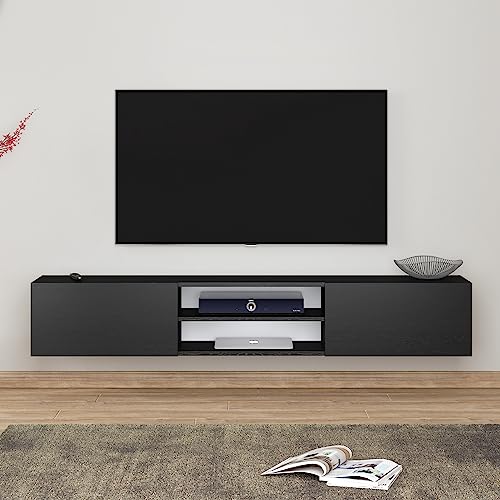 Waco Modern Floating TV Stand Wall Mount Media11.8'' H x 70.8'' W x 11.8'' D11.8 x 70.8 x 11.8 inches55 PoundsCheck on Amazon

Top 3 picks at a glance
Decide These 3 Things First
Before you compare any spec sheet, lock in these three decisions. They determine which weight rating you actually need.
1. What will live on it, with real weights. Weigh or look up everything you plan to place: TV stands and soundbars are not the issue (most wall-mounted consoles are not meant to hold the TV itself), but a center channel speaker (15-30 lbs), AV receiver (20-35 lbs), gaming consoles (8-15 lbs each), plus books, decor, and storage baskets. Add it up. A minimalist setup with a soundbar and streaming stick may total 25-40 lbs. A full home theater console with receiver, center channel, and two consoles can easily hit 90-130 lbs.
2. Your wall structure. Drywall over wood studs (16 inches on center in most American homes, 24 inches in some newer construction), metal studs, plaster over lath, or concrete/masonry all require different hardware. The weight rating on the box almost always assumes wood stud installation. If you have metal studs or plaster, your effective rating drops by 40-60% unless you use specialized anchors or blocking.
3. Your installation commitment. Are you willing to open the wall to add blocking, use a french cleat, or hit at least two to three studs? Or do you want a no-drill or minimal-drill solution? Your answer immediately filters the category from a true floating media console (wall-mounted cabinet) to a floating shelf, which has a very different rating system.
Size, Span, and How Weight Is Distributed
Weight rating means little without dimensions. A 100 lb rating on a 46-inch wide console behaves very differently than 100 lbs on a 60-inch or 78-inch span.
Width and support points: A 46-inch console will typically span two studs when centered correctly. A 60-inch console can span three studs, which dramatically increases shear strength if the mounting rail is designed to hit all three. A 70 to 78-inch console will span four studs but is far more prone to deflection (sagging in the middle) because the unsupported span between the outermost mounting points can exceed 48 inches. For anything over 60 inches wide, look for a continuous steel mounting rail or french cleat that runs at least 80% of the console’s width, not two small brackets.
Depth matters for leverage: Most floating consoles are 14 to 17.5 inches deep. The deeper the console, the more leverage the load exerts on the wall. A 30 lb receiver placed at the front edge of a 16-inch deep shelf creates significantly more pull-out force on the top anchors than the same receiver pushed against the wall. Ratings assume evenly distributed weight, usually centered and pushed back.
Point load vs. distributed load: Manufacturers test with evenly distributed weight (sandbags across the entire top). A 100 lb distributed rating may only be 60-70 lbs if you put all the weight in the center compartment. Check the manual for point load limits per compartment or per shelf. Quality brands list both: for example, “100 lbs total, 50 lbs per compartment.”
Clearance and height: Standard mounting height is 18 to 24 inches off the floor for a floating console under a wall-mounted TV. Higher mounting increases visibility of deflection and puts more stress on upper fasteners if the load is not level.
Material and Panel Construction
The material determines whether the console itself can handle the rating the wall hardware can hold.
Solid wood and plywood: The most reliable for high ratings. A console built with 3/4-inch plywood or solid wood for the top, bottom, and back rail will resist sagging and screw pull-out far better than particleboard. Expect premium consoles to use plywood with wood veneer and solid wood drawer fronts.
MDF and particleboard: Common in budget to mid-range models from $90 to $220. MDF is acceptable for lighter loads (under 75 lbs) if it is at least 5/8-inch thick and has a full back panel and internal bracing. Particleboard with a hollow core or thin 1/2-inch panels will sag over time even under 50 lbs, especially in humid environments or spans over 50 inches. Look for weight of the unit itself as a clue: a 60-inch particleboard console that ships at 38-45 lbs is likely thin-panel construction; a plywood equivalent of the same size will ship at 58-75 lbs.
Hardware insertion: Screws and cam locks hold far better in plywood than in particleboard. If the mounting rail attaches to the console with wood screws into particleboard without metal inserts, the rating is limited by the panel, not the wall.
Top thickness and bracing: A quality floating console top should be 3/4-inch to 1 inch thick, often double-layered. For spans over 55 inches, look for an internal vertical divider or aluminum reinforcement channel under the top panel to prevent long-term deflection.
Construction and Mounting Hardware
This is where most ratings succeed or fail. Two consoles with the same “100 lb” claim can have completely different hardware.
What the rating actually includes: Read the fine print. The best listings state: “Weight capacity: 100 lbs when mounted to wood studs with included hardware. Drywall anchors alone: 25-30 lbs maximum.” If there is no mention of studs, assume the rating is for ideal stud mounting and will be much lower with anchors alone.
The mounting system:
- Continuous french cleat (steel or solid wood): Highest and most even weight distribution. The console hangs on an interlocking rail bolted to studs. Preferred for 75 lbs and up.
- Steel mounting rail with multiple slots: Also excellent if it is at least 11-gauge steel (about 1/8 inch thick) and has 6-12 pre-drilled holes to hit studs anywhere along the width.
- Individual L-brackets or small cleats: Common on budget floating shelves. Two small brackets concentrate stress on two points. Even if rated for 50 lbs, they are more likely to loosen over time.
Fasteners: For wood studs, you want 1/4-inch x 2.5 to 3-inch lag bolts or structural wood screws (like SPAX or GRK), not just #8 wood screws or drywall screws. For concrete or block, you need 3/16 or 1/4-inch concrete sleeve anchors. Toggle bolts (1/4-inch or 3/8-inch) are the minimum acceptable for drywall-only mounting, but reduce the safe load to 30-50 lbs total regardless of the console’s rating.
Back panel engineering: A full 1/4 to 1/2-inch back panel that ties the top, bottom, and sides together prevents racking. Open-back or thin hardboard backs offer little structural help and often mean the rating is overstated.
Real-World Performance: What You Actually Put On It
Comfort in this category is not about cushioning; it is about stability, vibration, and daily use.
Vibration and resonance: A heavy AV receiver with a spinning disc drive or a powerful center channel can cause a lightly-built floating console to vibrate or buzz. Heavier, well-damped construction (over 55 lbs unit weight for a 60-inch console) stays quieter. Look for soft-close hinges and adjustable feet or wall bumpers that let you level the unit and prevent wobble.
Heat: Receivers and gaming consoles need ventilation. A console rated for 100 lbs but with an enclosed cabinet and only a small cable cutout will trap heat, even if weight is not an issue. Look for at least 2-3 inches of clearance above a receiver, open back sections, or vented shelves. Most receivers require 4-6 inches of top ventilation and exhaust 150-400 watts of heat under load.
Cable load: Do not forget cable and power brick weight. A power strip, 6-8 HDMI and power cables, and external power supplies can add 5-10 lbs gathered behind the console, pulling backward on the mounting rail.
Dynamic load: Ratings are for static weight. Leaning on the console (a 150 lb person briefly putting 40 lbs of force on the front edge while plugging something in), kids climbing, or a dog jumping up creates momentary loads 2-3 times heavier than the static weight. If the console is in a high-traffic area or kids’ room, choose a rating at least 50% higher than your calculated static load.
Price Tiers: What Your Money Buys
Price is a useful proxy for construction and hardware quality in this category.
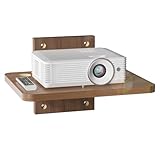
Budget: $20 to $90 – Floating Shelves and Small Tier Shelves This tier includes single-tier glass or MDF wall shelves like projector and DVD shelves. Typical rating is 15-30 lbs when mounted to studs, 10-15 lbs on drywall anchors. Dimensions are small (15 x 11 inches to 24 x 10 inches). Fine for a streaming box, small projector (5-10 lbs), or router, but not a substitute for a media console. Hardware is often two small brackets with modest screws.
Mid-Range: $150 to $280 – 46 to 60-Inch Floating Consoles This is the sweet spot for most buyers. Examples include 46-inch and 60-inch mid-century wall mount consoles with two to three compartments and drawers. Expect MDF or plywood with veneer, a steel mounting rail, and ratings of 75-150 lbs distributed when into studs. A 46-inch model in this range often ships in one box at 48-62 lbs; a 60-inch model ships at 60-78 lbs. This tier handles a soundbar, two gaming consoles, and storage without sagging if installed correctly.
Premium: $350 to $700+ – 70 to 78-Inch and Solid Wood Consoles Larger spans, solid wood or marine-grade plywood, continuous french cleats, and ratings of 150-250 lbs. These consoles often include internal aluminum reinforcement, soft-close hardware, and cable management channels. They are designed to remain dead-flat across a long span and often offer a per-shelf rating of 50-75 lbs. Installation is heavier and usually requires two people and precise stud finding.
Warranty, Support, and Delivery/Assembly
Warranty: Most floating consoles and shelves offer a 1-year limited warranty covering manufacturing defects. Mid-range and premium brands may offer 2-5 years on the cabinet and 5 years to limited lifetime on mounting hardware. Particleboard sagging from overloading or humidity is almost never covered. Keep your receipt and photos of the stud mounting if you need to make a claim.
Delivery: A 46-inch floating console usually ships in one box (50 x 20 x 12 inches, 50-65 lbs) via standard parcel. A 60 to 78-inch model often ships in two boxes or one oversized box (62-80 x 18-22 x 14 inches, 70-110 lbs total) that may require freight or threshold delivery. Check if the delivery is curbside, threshold, or white-glove, and whether the carrier will bring it upstairs. Shelves like the single-tier projector shelf ship in a small 16-18 inch box under 5 lbs.
Assembly and installation: Most consoles require 45-90 minutes of assembly for the cabinet plus 30-60 minutes for wall mounting with two people. You will need a stud finder, level (48-inch preferred), drill with 3/16 and 1/4-inch bits, and a socket driver for lag bolts. Do not use a drywall anchor as a substitute for a missed stud. If you cannot hit at least two studs, install a horizontal 3/4-inch plywood backer board across three studs first, then mount the console rail to that board. Professional installation typically costs $120 to $250 and is worth it for consoles over 60 inches or over 100 lbs total load.
Spec Checklist
| Spec | Budget | Mid | Premium |
|---|---|---|---|
| Total Weight Rating (into wood studs, distributed) | 15-30 lbs | 75-150 lbs | 150-250 lbs |
| Per-Compartment / Per-Shelf Rating | 15 lbs | 35-50 lbs | 50-75 lbs |
| Mounting System | 2 small brackets | Steel rail / cleat, 60-80% width | Continuous french cleat, full width, 11-gauge steel |
| Fasteners Included | #8 wood screws, plastic anchors | 1/4 x 2.5 in. lag bolts, toggle bolts | 1/4 x 3 in. structural screws, concrete anchors |
| Panel Material / Top Thickness | 1/2 in. MDF / particleboard | 5/8-3/4 in. MDF or plywood + veneer | 3/4-1 in. plywood / solid wood, reinforced |
| Typical Width / Depth | 15-24 in. W / 10-12 in. D | 46-60 in. W / 14-16 in. D | 70-80 in. W / 14-17.5 in. D |
| Unit Shipping Weight (clue to build) | 3-8 lbs | 50-78 lbs | 85-130 lbs |
| Price Range | $20 – $90 | $150 – $280 | $350 – $700+ |
Red Flags
No stud requirement listed. If a 60-inch console claims “holds up to 150 lbs” with no mention of studs, stud spacing, or hardware type, assume that rating was achieved in a lab with ideal blocking you do not have. Reduce expectations by half until you verify.
Only plastic expansion anchors included for a large console. A true floating media console should never rely on plastic anchors alone. If the box contains only small plastic anchors and short screws, the manufacturer is not serious about the rating.
Thin hardboard back panel and no center support on a long span. Press on the top in the middle in the showroom or check reviews for sag photos. A 70-inch span with 1/2-inch top and no divider will develop a visible dip under 40-50 lbs within a year.
Vague or missing per-shelf rating. “100 lbs total” with no breakdown often hides a weak shelf. A glass shelf or thin MDF shelf inside may only be rated for 15-20 lbs, so your receiver could break the shelf even though the wall mounting holds.
Weight rating that exceeds the unit’s own mounting logic. If a 38 lb particleboard console claims 200 lbs capacity with two small 6-inch brackets, the numbers do not add up. Hardware and panel strength should be proportional to the claim.
No mention of wall type limits or dynamic load warnings. Reputable brands warn not to lean, sit, or climb on the console and provide separate anchor guidance for concrete, metal studs, and drywall-only. Absence of those warnings is a sign of incomplete testing.
FAQ
Can I mount a floating console with drywall anchors only?
You can, but you must drastically lower the expectation. Even heavy-duty 1/4-inch toggle bolts in 1/2-inch drywall typically hold 40-55 lbs each in shear, but pull-out strength is much lower when leverage is applied at the front edge of a deep console. For a floating shelf under 24 inches wide, toggles can safely hold 25-35 lbs total. For a full media console over 40 inches wide, drywall-only mounting is not recommended for more than 30-50 lbs total, and long-term sagging or wall damage is likely. Hit at least two wood studs for anything over 50 lbs.
Does the TV weight count toward the console’s weight rating?
No, if the TV is wall-mounted separately above the console on its own mount, its weight does not count toward the console rating. If you plan to set the TV directly on top of the floating console on its feet or stand, then yes, a 55-inch TV (30-40 lbs) or 75-inch TV (55-75 lbs) counts entirely toward the rating and is often the single heaviest point load. Most floating consoles are designed for the TV to be wall-mounted above, so check whether the listed rating assumes a wall-mounted TV or a TV standing on the console.
How do I know if my rating is enough for a receiver and center channel?
Add the actual weights and then add a 50% safety margin for uneven distribution and dynamic load. For example, a 28 lb receiver plus a 22 lb center channel plus 15 lbs of consoles and decor equals 65 lbs static. Look for a console rated for at least 95-100 lbs distributed into studs, with at least 40-50 lbs per compartment. Also verify the internal shelf or drawer bottom can handle the receiver’s 28 lbs concentrated on four small feet, not just the top panel.
Why does my console sag in the middle even though I am under the weight limit?
Sag is about stiffness, not just ultimate strength. A long span (over 55 inches) with a thin or particleboard top will deflect slowly under sustained load, even at 60% of its rated limit, especially if weight is concentrated in the center or the room is humid. Heat from components can also soften MDF over time. Choosing a plywood top of 3/4 inch or thicker, a model with a center vertical divider, or a console with an internal metal reinforcement channel eliminates most visible sag. If you already have sag, redistribute weight toward the ends near the stud-mounted rail and ensure the mounting rail itself is level and tight to the wall.
Related guides
- Best Free MMOs on Steam: Subscription Limits, Pay-to-Win and Time Cost (2026)
- Best Free Horror Games on Steam: How to Pick One That Fits Your PC and Your Nerves (2026)
- Black Frame Insertion vs VRR: Which Smoothness Feature Should You Use?
- Best Webcams for Streaming: 11 Listings Compared by Resolution, Focus and Light (2026)