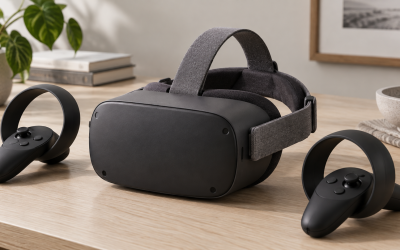
VR controllers are the one part of the kit that can quietly die mid-session, yanking you out of immersion at the worst moment. Knowing roughly how long they last, what drains them, and how to keep them topped up saves a lot of frustration. This guide covers realistic battery life for typical motion controllers, the factors that shorten it, and simple habits and accessories that keep your controllers ready whenever you want to play.
Typical battery life
Most VR motion controllers run on either a single or a pair of AA batteries, or a built-in rechargeable cell. Life varies with how hard you play, but the ranges below are a fair guide.
| Power source | Typical life per charge or set | Notes |
|---|---|---|
| Single AA (per controller) | Roughly 20 to 30 hours | Haptics and tracking LEDs drain faster |
| Rechargeable AA (NiMH) | Roughly 15 to 25 hours per charge | Slightly lower voltage, easy to recharge |
| Built-in rechargeable | Roughly 8 to 15 hours per charge | Recharge via dock or cable |
Heavy rumble effects, bright tracking rings, and always-on hand-tracking cameras all pull more power, so an action game will chew through cells faster than a calm seated experience.
What drains controllers fastest
Three things dominate: haptic feedback, the infrared or visible LEDs used for tracking, and the wireless radio. Games with constant vibration, such as shooters and rhythm titles, drain batteries noticeably quicker than slow-paced ones. Leaving controllers awake instead of letting them sleep between sessions also quietly wastes power over a week.
Rechargeable versus disposable
For anyone who plays regularly, rechargeable AA cells or a dedicated charging dock pay for themselves fast and cut waste. Good NiMH batteries deliver most of the runtime of disposables and can be cycled hundreds of times. A charging dock that holds the controllers when not in use means they are always near full, and some double as a tidy stand.
Habits that extend life
Remove or turn off controllers when you finish, rather than leaving them idle. Keep a charged spare set on hand so a dead controller never ends a session. If you use disposables, lithium AA cells last longer than standard alkalines and handle high drain better. Storing batteries at room temperature also preserves their capacity.
Planning around battery life
If you host guests or run long sessions, do the math: two controllers each drawing on one AA might need a fresh set or a recharge after a full day of heavy play. A four-bay charger with two batteries in use and two charging keeps you running indefinitely with no downtime.
Building a no-downtime charging routine
The goal for regular players is simple: never be surprised by a dead controller. The easiest way to get there is a small routine built around rechargeables. A four-bay charger with two cells in use and two on charge means you always have a fresh pair ready to swap in, and the whole cycle costs little after the initial purchase. If your controllers use built-in batteries, a charging dock that holds them between sessions keeps them near full and doubles as tidy storage. Whichever route you take, get into the habit of turning controllers off or docking them the moment you finish, since idle controllers slowly waste power over a week. It also helps to keep a note of roughly how long your setup lasts under your typical games, so you can plan ahead for long sessions or when guests visit. For anyone hosting parties or running demos, having a spare charged set on hand is the difference between a smooth afternoon and an abrupt stop. A few dollars of rechargeable cells and thirty seconds of routine remove battery anxiety for good.
FAQ
Are rechargeable batteries worth it for VR controllers?
For regular players, yes. Rechargeable NiMH cells or a charging dock quickly offset their cost, reduce waste, and keep controllers near full so you rarely get caught with a dead one mid-game.
Why does one controller die faster than the other?
Usually because it does more work. The controller in your dominant hand often triggers more haptics and button presses, and slight differences between battery cells add up, so uneven drain is normal.
Bottom line
Expect roughly 20 to 30 hours from disposable AA controllers, somewhat less from rechargeables and built-in cells, with fast-paced haptic-heavy games at the low end. Switch to rechargeable cells or a charging dock, keep a spare set ready, and let controllers sleep between sessions. Do that and battery life stops being something you ever worry about mid-play.