Choosing a graphics card is really a decision about what your monitor and your games ask of it. A card that is perfect for 1080p play can stutter at 1440p, and a card built for 4K is wasted on a 60Hz display, so the right buy starts with the resolution you play at, the games you play most, and the power supply and case you already own. Get those three answers right and the model almost picks itself.


This guide is for first-time builders, upgraders replacing an old card, and gamers moving from 1080p to 1440p or 4K. It covers the full range, from an 8GB entry card to 16GB high-end picks from Nvidia and AMD, and every card below is listed by name and specification from its Amazon listing.
Quick Picks
As an Amazon Associate we earn from qualifying purchases.
| Product | Best for | Key spec |
|---|---|---|
| ASUS Dual GeForce RTX 5060 OC 8GB | First builds and 1080p gaming | 8GB GDDR7, DLSS 4, 0dB fans |
| MSI GeForce RTX 5070 Ventus 2X OC 12GB | Smooth 1440p gaming | 12GB GDDR7, 192-bit bus, dual fans |
| XFX Swift Radeon RX 9070 OC 16GB | 1440p with memory headroom | 16GB GDDR6, RDNA 4, triple fans |
| GIGABYTE GeForce RTX 5070 Ti Eagle OC SFF 16G | Compact high-end builds | 16GB GDDR7, 256-bit bus, SFF-Ready |
| XFX Mercury Radeon RX 9070 XT OC 16GB | 4K gaming and heavy textures | 16GB GDDR6, boost up to 3100 MHz, RGB |
How to Choose
Match memory to the resolution you actually play at
Memory capacity decides how much texture and scene data a card holds at once, and running out of it causes stutter that no clock speed can fix. At 1080p, 8GB still handles most current games at high settings, but newer releases with large texture packs already push against that limit, so an 8GB card is a shorter-lived choice than a 12GB or 16GB one. If you keep a card for four or more years, treat 12GB as the practical floor and 16GB as the comfortable buy, even at 1080p. Check the memory figure on the listing itself, not the model name, because several models ship in more than one memory configuration.
Check power draw and connectors before you order
A graphics card can stop being a simple upgrade the moment it needs a new power supply, so read the board power and connector requirements on the listing before ordering. Cards in this guide range from modest draws that suit a mid-range supply to hungrier designs that need a stronger unit and the right PCIe power cables. Add the card’s draw to roughly 100 to 150W for a mid-range processor and platform, then leave headroom for brief spikes. Also confirm the connector type, because some newer cards use a different power connector than older supplies provide, and an adapter is a workaround, not a plan.
Measure the card against your case, not the box
Length, thickness and slot count are the most common reasons a graphics card gets returned, and they have nothing to do with performance. A triple-fan card can run 300mm or longer, and a 2.5-slot cooler can block the slot below it, which matters in compact cases and small-form-factor builds. The listing gives the card’s dimensions and slot width, and your case maker lists maximum graphics card clearance, so compare those two numbers directly. Leave room for airflow as well: a card pressed against a case panel or a drive cage runs hotter and louder than the same card with space around it.
Weigh the generation, not just the model number
A newer generation brings features an older card cannot add later, such as newer upscaling support, current display outputs and better video encoding. The RTX 50-series cards support DLSS 4 frame generation features that earlier generations do not, while AMD’s RDNA 4 cards bring newer encoding and upscaling than RDNA 3. That does not make older cards bad buys: a 12GB card from an earlier generation can outlast an 8GB card from a newer one in texture-heavy games. Compare generation features against memory capacity together, and let the games you play most decide which matters more.
The 5 Best Options
ASUS Dual GeForce RTX 5060 OC 8GB
The ASUS Dual RTX 5060 OC is the straightforward entry pick for a first build or a quiet 1080p machine. Its 8GB of GDDR7, PCIe 5.0 interface and DLSS 4 support cover current games at 1080p with high settings, and the dual Axial-tech fans with 0dB technology stop spinning at idle, so the card stays silent on the desktop. HDMI 2.1b and DisplayPort 2.1b cover modern monitors, and the 2.5-slot design fits most standard mid-tower cases without a fight.
Specs
- Memory: 8GB GDDR7
- Boost clock: 2535 MHz default, 2565 MHz OC mode
- Architecture: Blackwell, DLSS 4 support
- Interface: PCIe 5.0
- Outputs: HDMI 2.1b, DisplayPort 2.1b
- Cooling: Dual Axial-tech fans, 0dB technology, 2.5-slot design
- Maximum resolution: 7680×4320
- Model: DUAL-RTX5060-O8G
Best for: First-time builders and quiet 1080p gaming setups.
Watch out for: 8GB of memory fills quickly in newer texture-heavy titles, so expect to lower texture settings sooner than with a 12GB or 16GB card.
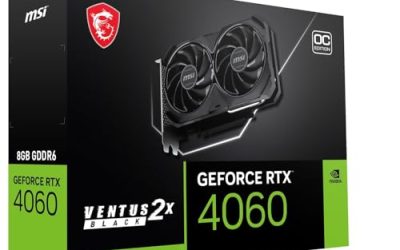
MSI GeForce RTX 5070 Ventus 2X OC 12GB
The MSI RTX 5070 Ventus 2X OC is the mid-range pick for gamers stepping up to 1440p. Its 12GB of GDDR7 on a 192-bit bus gives real texture room, and the dual-fan Ventus cooler keeps the card compact enough for smaller mid-tower cases that triple-fan cards cannot fit. Blackwell architecture with DLSS 4 support covers current games at high settings, and three DisplayPort 2.1a outputs plus HDMI 2.1b drive modern high-refresh monitors without adapters.
Specs
- Memory: 12GB GDDR7, 192-bit bus
- Boost clock: 2542 MHz
- Architecture: Blackwell, DLSS 4 support
- Interface: PCIe 5.0
- Outputs: 3x DisplayPort 2.1a, HDMI 2.1b
- Cooling: Dual-fan Ventus design
- Model: V532-003R
Best for: Gamers moving to 1440p who want a compact dual-fan card.
Watch out for: 12GB is comfortable at 1440p today, but the heaviest 4K texture packs can push against it, so this is not the card for a 4K monitor.
XFX Swift AMD Radeon RX 9070 OC Triple Fan 16GB
The XFX Swift RX 9070 OC is the memory headroom pick: 16GB of GDDR6 on AMD’s RDNA 4 architecture, with a triple-fan cooler and HDMI plus triple DisplayPort outputs. That capacity is the reason to choose it over 8GB rivals at the same tier, because it holds high-resolution textures and stays comfortable as games grow more demanding. It is the longest-lived card in this guide for a gamer who keeps hardware for years and plays at 1440p.
Specs
- Memory: 16GB GDDR6
- Memory clock: 20 Gbps
- Architecture: RDNA 4
- Cooling: Triple-fan cooler, OC edition
- Outputs: HDMI, 3x DisplayPort
- Maximum resolution: 3840×2160
- Interface: PCI-Express x16
- Model: RX-97SWFB3B9
Best for: 1440p gamers who want 16GB of memory and a card that stays useful for years.
Watch out for: Ray tracing performance trails the Nvidia cards at this tier, and some tools and mods favor Nvidia features, so check your most-played games first.
GIGABYTE GeForce RTX 5070 Ti Eagle OC SFF 16G
The GIGABYTE RTX 5070 Ti Eagle OC SFF is the high-end pick for smaller builds. Its 16GB of GDDR7 on a 256-bit bus, PCIe 5.0 interface and Blackwell architecture with DLSS 4 support handle demanding titles at 1440p and 4K, while the NVIDIA SFF-Ready design and WINDFORCE cooling fit cases that full-length triple-fan cards cannot. It is the card to choose when you want top-tier performance without rebuilding around a large case.
Specs
- Memory: 16GB GDDR7, 256-bit bus
- GPU clock: 2600 MHz
- Architecture: Blackwell, DLSS 4 support
- Interface: PCIe 5.0
- Outputs: DisplayPort, HDMI
- Cooling: WINDFORCE cooling system
- Design: NVIDIA SFF-Ready
- Model: GV-N507TEAGLE OC-16GD
Best for: High-end gaming in compact and small-form-factor cases.
Watch out for: Even an SFF-Ready card needs its power and clearance checked against your case and supply, and the cooler still takes two slots, so confirm the slot below it is free.
XFX Mercury AMD Radeon RX 9070 XT OC Gaming 16GB
The XFX Mercury RX 9070 XT OC is the strongest AMD card in this guide and the pick for 4K gaming on this side of the list. Its 16GB of GDDR6, boost clock up to 3100 MHz and triple-fan MERC cooler with RGB handle 4K texture packs and demanding titles, while three DisplayPort outputs plus HDMI drive up to four displays. RDNA 4 brings current upscaling and encoding, so it suits both gaming and creative work that leans on memory capacity.
Specs
- Memory: 16GB GDDR6
- Boost clock: Up to 3100 MHz
- Architecture: RDNA 4
- Cooling: MERC triple-fan cooling solution with RGB
- Outputs: 3x DisplayPort, HDMI
- Model: RX-97TRGBBB9
- Warranty: 3-year manufacturer warranty
Best for: 4K gaming, heavy textures and multi-monitor setups.
Watch out for: The triple-fan MERC shroud needs a roomy mid-tower, so measure case clearance first, and RGB lighting control requires XFX software.
Which One Fits Your Situation
You are building your first gaming PC
Pick the ASUS Dual RTX 5060 OC. It covers 1080p gaming with current features, runs quietly thanks to its fan-stop design, and fits standard cases without clearance drama. Its modest power needs also keep the rest of the build simple, since you will not need an oversized supply to support it.
You are upgrading for smooth 1440p play
Pick the MSI RTX 5070 Ventus 2X OC. Its 12GB of GDDR7 and dual-fan design suit a 1440p monitor in a normal mid-tower, and DLSS 4 support keeps frame rates steady in current games. It is the balanced step up from an entry card without moving into high-end territory, and its compact size fits cases that triple-fan cards cannot.
You want the card to last the longest
Pick the XFX Swift RX 9070 OC. Memory capacity is the spec that ages slowest, and 16GB gives the most room for future texture packs and higher settings at 1440p. The triple-fan cooler and RDNA 4 architecture round out a card built to stay in service for years without forcing an early upgrade.
You play at 4K or build in a compact case
Pick the XFX Mercury RX 9070 XT OC for 4K gaming and heavy textures, with its 16GB of memory and boost clock up to 3100 MHz. If your case is compact instead, pick the GIGABYTE RTX 5070 Ti Eagle OC SFF, which brings the same 16GB tier into an SFF-Ready design that fits smaller builds.
Common Mistakes
- Buying a card for a monitor you do not own yet: match memory and tier to the resolution you play at today.
- Ignoring the power supply: a card that needs a stronger unit or a different connector turns a simple upgrade into a second purchase.
- Skipping the tape measure: triple-fan cards and 2.5-slot coolers do not fit every case, and clearance is listed by both the card and the case maker.
- Choosing by model name alone: the same model name can ship with different memory sizes, so read the memory figure on the listing.
- Paying for a tier above your monitor: a 1080p 60Hz display cannot show what a high-end card renders, so spend where you can see the difference.
Frequently Asked Questions
How much VRAM do I need in 2026?
At 1080p with high settings, 8GB remains workable in most current titles. Newer releases with large texture packs already push against it, though, so if you keep cards for four or more years, 12GB or 16GB is the safer purchase even at 1080p, and 16GB is the comfortable choice for 1440p and 4K.
Should I buy AMD or Nvidia?
AMD generally offers more memory for the money at this tier, as the 16GB RX 9070 and RX 9070 XT show. Nvidia generally leads on ray tracing, upscaling quality and creative-app acceleration. If ray tracing is optional for you, AMD usually gives more for the same spend; if it matters, Nvidia is the safer choice.
Will a new graphics card work in my older PC?
Yes, in most cases. These cards use PCIe 5.0 or PCIe 4.0, which work in older PCIe slots at a lower link speed, and they fit standard desktop boards. Check your case length, slot width and power supply first, since those are the usual blockers, not the motherboard itself.
Do I need a new power supply for a new card?
Not usually for the entry and mid-range cards here, which run on modest supplies. The high-end 16GB cards draw more, so add the card’s draw to your processor and platform, then check your supply’s rating and its PCIe power connectors before ordering.
Related guides
More from Amazon
Programs that pair well with the guide above. Offers and eligibility are set by Amazon and may change.
Free shipping on eligible items, Prime Video and more. Eligible new members can start with a free trial.
Start a Prime free trialAd-free music streaming. Eligible new subscribers can start with a free trial.
Try Music Unlimited freeA Prime membership for ages 18-24 with a trial period. Eligibility is set by Amazon.
See Prime for Young AdultsAudiobooks and podcasts to listen to on the go. Eligible new members can start with a free trial.
Try Audible freeAs an Amazon Associate we earn from qualifying purchases.