Our Short List of 3
All 5 Picks at a Glance
| Product | Specs | Action |
|---|---|---|
 Crucial T705 2TB (ASIN: B0CTRVZKG7) | Check price on Amazon | |
 Samsung 990 PRO 2TB (ASIN: B0BHJJ9Y77) | Check price on Amazon | |
 WD_BLACK SN850X 2TB (ASIN: B0B7CMZ3QH) | Check price on Amazon | |
 Samsung 870 EVO 1TB (ASIN: B08QBJ2YMG) | Check price on Amazon | |
 Crucial MX500 1TB (ASIN: B078211KBB) | Check price on Amazon |
Disclosure: As an Amazon Associate, we may earn from qualifying purchases made through links on this page, at no additional cost to you.
NVMe vs SATA SSD: Which One Should You Buy?
The NVMe vs SATA SSD question looks like a contest between two kinds of flash storage, but the flash itself is not what separates them. The real difference is the road the data travels on. A SATA SSD sends everything through SATA III, a connection designed in the hard drive era that tops out at 6 Gbps, a hard ceiling of roughly 600 MB/s no matter how fast the memory chips are. An NVMe SSD skips that legacy path and talks to the system over PCI Express, the same bus used by graphics cards. A PCIe 4.0 x4 link raises the theoretical ceiling to about 8,000 MB/s, and PCIe 5.0 x4 doubles it to roughly 16,000 MB/s.
That gap explains the headline numbers on the boxes, but it does not mean every task runs proportionally faster on NVMe. Booting Windows, opening office apps and loading many games narrow the difference, because those jobs depend on small random reads and CPU work as much as raw transfer speed. Where NVMe pulls clearly ahead is sustained throughput: moving huge game libraries, scrubbing high-resolution video, working with large project files, and titles built around Microsoft DirectStorage. SATA still earns its place through compatibility: most desktops and older laptops have SATA bays and cables, while M.2 slots are limited and sometimes absent.
This comparison puts five current drives head to head: three NVMe models covering PCIe 5.0 and 4.0, and two SATA models showing how far the older interface can be pushed. For a gaming or PCVR rig, the answer depends on your slots, your workload and how much storage you need.
Our Top Picks
Top 3 picks at a glance
Quick Picks
- Fastest NVMe, PCIe 5.0: Crucial T705 2TB — View on Amazon
- PCIe 4.0 flagship: Samsung 990 PRO 2TB — View on Amazon
- Gaming-tuned NVMe: WD_BLACK SN850X 2TB — View on Amazon
- Best SATA all-rounder: Samsung 870 EVO 1TB — View on Amazon
- SATA capacity pick: Crucial MX500 1TB — View on Amazon
Crucial T705 2TB (ASIN: B0CTRVZKG7)
The T705 is the NVMe side of this comparison at full stretch. It is a PCIe 5.0 x4 drive in the standard M.2 2280 format, built on Micron TLC NAND, and Crucial rates the 2TB model at sequential reads up to 14,500 MB/s and writes up to 12,700 MB/s, close to the practical limit of a Gen5 x4 link and roughly twenty-five times the sequential throughput any SATA drive can reach. This is the non-heatsink variant (model CT2000T705SSD3), and Crucial is explicit that it must run under a motherboard heatsink or aftermarket cooler with proper airflow, because Gen5 controllers throttle when they overheat.
The listing also highlights optimization for Microsoft DirectStorage, support for Intel 13th and 14th Gen and AMD Ryzen 7000 platforms, and backward compatibility with Gen4 and Gen3 slots, where it runs at the older link speed. It carries a 5-year limited warranty, and the package includes a one-month Adobe Creative Cloud All-Apps trial. For a high-end build with a Gen5 slot, this drive shows what NVMe can do when nothing holds it back.
Highlights:
– PCIe 5.0 x4 interface with sequential reads up to 14,500 MB/s
– TLC NAND and DirectStorage optimization for fast game loading
– Backward compatible with PCIe 4.0 and 3.0 M.2 slots
– 5-year limited warranty
Considerations:
– Needs a Gen5 M.2 slot to reach full speed; runs slower on older boards
– Requires a heatsink and decent case airflow to avoid thermal throttling
– Overkill for basic office or web workloads
Samsung 990 PRO 2TB (ASIN: B0BHJJ9Y77)
The 990 PRO represents the mature end of PCIe 4.0. Samsung rates this 2TB model (MZ-V9P2T0B/AM) at sequential reads up to 7,450 MB/s and writes up to 6,900 MB/s, close to the practical ceiling of a Gen4 x4 link and more than twelve times the sequential speed of the fastest SATA SSD. It uses Samsung’s in-house controller with a 2GB LPDDR4 DRAM cache on this capacity, in a slim single-sided M.2 2280 design that fits laptops and compact desktops. Samsung also emphasizes power efficiency, a useful trait in small builds where heat and battery draw matter.
The drive carries a 5-year manufacturer warranty and works with Samsung Magician software for firmware updates, health monitoring and migration. As a Gen4 drive it fits far more motherboards than a Gen5 model, and it meets PlayStation 5 expansion speed requirements when paired with suitable cooling. For most gaming PCs, this class is the realistic NVMe sweet spot: nearly all the headroom a Gen4 slot can use, without Gen5 cooling demands.
Highlights:
– Sequential reads up to 7,450 MB/s and writes up to 6,900 MB/s
– Dedicated DRAM cache for stronger sustained and random performance
– Slim single-sided M.2 2280 design suits laptops and compact builds
– 5-year manufacturer warranty
Considerations:
– No heatsink on this variant; consoles and tight cases may need one added
– Runs at Gen3 speeds in older slots, narrowing its lead over SATA
– Gen5 drives are faster on paper for brand-new flagship builds
WD_BLACK SN850X 2TB (ASIN: B0B7CMZ3QH)
The SN850X is Western Digital’s gaming-focused Gen4 drive, sold under the SanDisk Technologies umbrella. This 2TB model (WDS200T2X0E) is rated at sequential reads up to 7,300 MB/s and writes up to 6,300 MB/s over PCIe Gen4 x4, using TLC 3D NAND. The line spans 1TB up to 8TB, so one M.2 slot can hold a game library that would otherwise spill across several SATA drives. This listing is the non-heatsink version; a heatsink variant is sold for console use.
What sets the SN850X apart is its gaming software layer. The downloadable SANDISK Dashboard for Windows can enable Game Mode 2.0 features such as predictive loading and overhead balancing, and the drive supports Microsoft DirectStorage, the API that lets games stream assets from NVMe storage with less CPU overhead. For a gaming PC or PCVR rig where fast level loads and texture streaming are the priority, that makes the SN850X a purpose-built alternative to the 990 PRO. It is also backward compatible with PCIe Gen3 slots at reduced speed.
Highlights:
– Sequential reads up to 7,300 MB/s over PCIe Gen4 x4
– Game Mode 2.0 and DirectStorage support aimed at game loading
– Capacities up to 8TB for very large libraries
– TLC 3D NAND with a gaming-tuned controller
Considerations:
– Dashboard software and Game Mode features are Windows only
– This variant has no heatsink; sustained writes in tight cases need cooling
– Peak speeds require a Gen4 slot; Gen3 systems see lower numbers
Samsung 870 EVO 1TB (ASIN: B08QBJ2YMG)
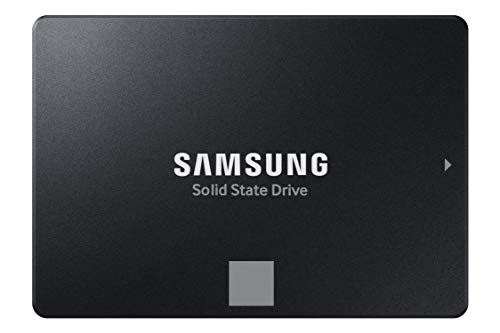
The 870 EVO shows the SATA interface at its absolute limit. Samsung rates it at 560 MB/s read and 530 MB/s write, which effectively saturates SATA III; no 2.5-inch SATA drive can go meaningfully faster, because the interface itself is the bottleneck. This 1TB model (MZ-77E1T0B/AM) uses Samsung V-NAND with a larger variable TurboWrite buffer to hold write speeds up over long transfers, and it is rated for up to 600 TBW of endurance under a 5-year limited warranty. The 2.5-inch, 7mm shell fits desktop bays, older laptops, NAS enclosures and consoles that accept SATA drives.
That compatibility is the point of the SATA side. An 870 EVO can revive a laptop with no M.2 slot, fill spare desktop bays, or add bulk game storage where the M.2 slots are already occupied. Samsung Magician software handles firmware updates and health checks. It cannot match NVMe throughput, and it does not pretend to; it is the benchmark for how good a SATA SSD can be.
Highlights:
– 560/530 MB/s sequential speeds saturate the SATA III interface
– 600 TBW endurance figure at 1TB with a 5-year limited warranty
– Universal 2.5-inch fit for desktops, laptops, NAS and consoles
– Samsung Magician software for health monitoring and updates
Considerations:
– Interface caps speed near 600 MB/s regardless of the flash inside
– No benefit from DirectStorage or other NVMe-only features
– Needs a SATA data cable and power connector, unlike slot-in M.2 drives
Crucial MX500 1TB (ASIN: B078211KBB)
The MX500 is the long-running mainstream SATA option from Crucial. This 1TB model (CT1000MX500SSD1) is rated at sequential reads up to 560 MB/s and writes up to 510 MB/s, figures printed in Crucial’s own comparison table on the product page, and it is built on Micron 3D NAND in the same universal 2.5-inch, 7mm format as the 870 EVO. Its dynamic write acceleration uses a pool of single-level-cell flash to keep write speeds up during mixed use, and the family stretches from 250GB up to 4TB.
In this comparison the MX500 makes the practical case for SATA: when a system has free bays but no free M.2 slots, or when the job is storing a large library of games, media and backups, a proven SATA drive delivers capacity without compatibility drama. Crucial supports it with a step-by-step install guide and cloning guidance aimed at first-time upgraders. Like every SATA model, its ceiling is the interface, not the NAND, so expectations should be set by the 560 MB/s read figure.
Highlights:
– Sequential reads up to 560 MB/s and writes up to 510 MB/s
– Micron 3D NAND with dynamic write acceleration
– Capacity range up to 4TB for bulk storage roles
– Standard 2.5-inch fit for desktops and older laptops
Considerations:
– Same SATA III speed ceiling as every 2.5-inch drive
– Slower sustained writes than the 870 EVO on long transfers
– No path to NVMe-only features such as DirectStorage
How to Choose
Start with your motherboard or laptop, not with the drives. Check how many M.2 slots you have, what PCIe generation each runs at, and which lengths they accept; 2280 is the common size for every NVMe pick here. M.2 slots can be keyed for NVMe, for SATA, or for both, and populating some slots disables SATA ports or reduces graphics card lanes on some boards, so the manual is the final authority. If a Gen5 slot is available and your workload moves very large files, the T705 uses it fully. With Gen4 slots, the 990 PRO and SN850X already saturate them.
Then match the drive to the job. The operating system and your most-played games benefit most from NVMe, especially DirectStorage titles and PCVR games with heavy texture streaming. Bulk libraries, media archives and backups are natural SATA work, where the 870 EVO and MX500 trade peak speed for easy capacity in open bays. Many builds end up mixed: one fast NVMe boot drive plus one or two large SATA drives. Finally, plan capacity with headroom, since SSDs slow down as they fill, and budget for a heatsink on Gen5 drives and on any drive going into a console or cramped case.
Key Specifications Explained
Interface and protocol. NVMe is a protocol designed for flash memory, with thousands of parallel queues; AHCI, which SATA SSDs use, was designed for spinning disks with a single queue. That is why NVMe drives post much stronger random performance alongside their higher sequential numbers. PCIe generations. Each generation roughly doubles per-lane bandwidth: Gen3 x4 allows about 4,000 MB/s, Gen4 x4 about 8,000 MB/s, and Gen5 x4 about 16,000 MB/s. Drives are backward compatible, but a Gen5 drive in a Gen3 slot performs like a Gen3 drive. SATA III. The 6 Gbps link delivers at most about 600 MB/s after overhead, which is why every quality SATA SSD clusters around 500 to 560 MB/s.
Form factor. M.2 2280 is a bare stick 22mm wide and 80mm long that mounts flat on the board; 2.5-inch drives are cased units that need a bay plus data and power cables. An M.2 slot wired only for SATA will not unlock NVMe speeds. DRAM cache. Drives like the 990 PRO carry dedicated DRAM to hold the map of where data lives, sustaining performance under heavy mixed loads. Endurance (TBW). Terabytes written states how much data a drive is warranted to write over its life; the 870 EVO’s 600 TBW at 1TB is a useful yardstick for the SATA side.
Setup and Use Tips
Installing an M.2 drive is a two-minute job: seat the stick at an angle, press it flat, and secure the screw without overtightening. Before booting, confirm in the BIOS that the slot is set to PCIe or NVMe mode where such a toggle exists. For a 2.5-inch SATA drive, connect the data cable to a motherboard SATA port and a power lead from the power supply, then check the port is enabled and set to AHCI mode. The drive makers’ cloning tools can move an existing Windows installation across; a clean install avoids carrying over old storage drivers.
After setup, update the firmware through the maker’s utility, Samsung Magician for the Samsung drives or the SANDISK Dashboard for the SN850X, and leave a slice of capacity unused so the controller has room for wear leveling. Gen5 drives and any drive in a PlayStation 5 should run under a heatsink. In a gaming or PCVR system, put the operating system and most-played titles on the NVMe drive and let SATA carry the back catalogue.
Common Mistakes to Avoid
The most common mistake is buying for the headline number instead of the slot. A Gen5 drive in a Gen4 board cannot exceed Gen4 speeds, and a Gen4 drive in a Gen3 slot is capped again, so speed beyond your link buys nothing until the next motherboard upgrade. The second mistake is confusing M.2 SATA with M.2 NVMe: they share a connector shape but speak different protocols, and a SATA-only M.2 slot will never deliver NVMe performance. Third, expecting game load times to scale with sequential speed leads to disappointment; many loads are limited by CPU decompression and small-file reads, which is why the jump from a hard drive to any SSD feels huge while SATA to NVMe feels modest in older titles.
Fourth, skipping cooling on fast NVMe drives invites thermal throttling that erases their advantage during long transfers. Fifth, filling any SSD to the last gigabyte hurts sustained write speed and wear leveling, so treat the last stretch of capacity as reserve. Finally, do not assume a console accepts any fast drive: the PlayStation 5 expansion slot requires a PCIe Gen4 NVMe drive with cooling, and a SATA SSD cannot serve that role at all.
FAQ
Can I use an NVMe SSD in a computer that only has SATA connections?
Not directly. NVMe drives need an M.2 slot wired for PCIe, or a PCIe adapter card in a desktop expansion slot. If the machine only offers SATA ports, a 2.5-inch SATA SSD such as the 870 EVO or MX500 is the correct upgrade, and it still transforms performance compared with a mechanical hard drive.
Is NVMe noticeably faster than SATA for gaming and VR?
For large file transfers and DirectStorage games, yes: Gen4 and Gen5 drives load assets far faster than the roughly 600 MB/s SATA ceiling. For booting, everyday apps and many older games, the gap is much smaller because those tasks are not purely bandwidth limited. PCVR players benefit most when the library lives on NVMe, while SATA remains fine for titles played less often.
Will a PCIe 5.0 NVMe drive work in a PCIe 4.0 or 3.0 board?
Yes. NVMe drives are backward compatible across PCIe generations, so a T705 will install and run in a Gen4 or Gen3 slot, limited to that link’s bandwidth. It becomes a sensible purchase if you plan a motherboard upgrade later, but on today’s board it performs like a drive from that older generation.
Can a PlayStation 5 use a SATA SSD in its expansion bay?
No. The PS5 expansion bay requires an M.2 NVMe drive on PCIe Gen4 with a heatsink, which is why the 990 PRO and SN850X offer heatsink variants. A SATA SSD can only connect through a USB enclosure, where it can store PS5 games and play PS4 games, but it cannot run PS5 titles.
How much capacity should I choose?
Work backward from your library: add the operating system, essential applications and the games you keep installed, then choose the next size up so the drive never runs nearly full. In practice, 1TB is a workable minimum for a gaming system, 2TB is comfortable for large libraries, and pairing a 2TB NVMe drive with a larger SATA drive efficiently holds everything else.
Final Verdict
NVMe wins this comparison on capability: the interface removes the ceiling that defines SATA, and the three NVMe picks span from the Gen4 maturity of the Samsung 990 PRO and the gaming tuning of the WD_BLACK SN850X to the Gen5 extremes of the Crucial T705. For a new gaming or PCVR build with free M.2 slots, NVMe is the right default for your system drive and most demanding games. SATA is not obsolete, though: the Samsung 870 EVO and Crucial MX500 remain the sensible answer for older machines without M.2 slots, for filling spare bays, and for bulk storage where 560 MB/s is genuinely enough. Decide by slots first, workload second, and the question answers itself.
Related guides
More from Amazon
Programs that pair well with the guide above. Offers and eligibility are set by Amazon and may change.
Free shipping on eligible items, Prime Video and more. Eligible new members can start with a free trial.
Start a Prime free trialAd-free music streaming. Eligible new subscribers can start with a free trial.
Try Music Unlimited freeA Prime membership for ages 18-24 with a trial period. Eligibility is set by Amazon.
See Prime for Young AdultsAudiobooks and podcasts to listen to on the go. Eligible new members can start with a free trial.
Try Audible freeAs an Amazon Associate we earn from qualifying purchases.